

[Sep 01, 2024] Pass Your Databricks-Certified-Data-Engineer-Associate Dumps Free Latest Databricks Practice Tests
Get Top-Rated Databricks Databricks-Certified-Data-Engineer-Associate Exam Dumps Now
The GAQM Databricks-Certified-Data-Engineer-Associate (Databricks Certified Data Engineer Associate) Certification Exam is a comprehensive examination that tests the skills of professionals who work with data on the Databricks platform. Databricks Certified Data Engineer Associate Exam certification is designed to help professionals stay up-to-date with the latest data engineering trends and technologies, and it can help professionals advance their career in the field of data engineering. By earning this certification, professionals can demonstrate their commitment to professional development and their dedication to staying current in their field.
Databricks Certified Data Engineer Associate certification is a valuable credential for professionals who work in data engineering. Databricks Certified Data Engineer Associate Exam certification demonstrates that the candidate has a deep understanding of data engineering concepts and has the skills and experience to work with Databricks effectively. Employers often look for candidates who hold this certification when hiring for data engineering roles, as it validates the candidate's expertise and knowledge in the field.
Databricks Certified Data Engineer Associate exam covers a wide range of topics, including data ingestion, data transformation, data storage, and data processing. Databricks-Certified-Data-Engineer-Associate exam is designed to test the skills and knowledge of candidates in using Databricks to build and optimize data pipelines. Databricks Certified Data Engineer Associate Exam certification exam also tests the knowledge of candidates in working with Databricks to perform data transformations and store data in a variety of formats. Successful candidates will have a deep understanding of Databricks and its capabilities, and will be able to use this knowledge to build efficient and effective data pipelines.
NEW QUESTION # 53
Which of the following data lakehouse features results in improved data quality over a traditional data lake?
- A. A data lakehouse enables machine learning and artificial Intelligence workloads.
- B. A data lakehouse supports ACID-compliant transactions.
- C. A data lakehouse stores data in open formats.
- D. A data lakehouse allows the use of SQL queries to examine data.
- E. A data lakehouse provides storage solutions for structured and unstructured data.
Answer: B
Explanation:
Explanation
One of the key features of a data lakehouse that results in improved data quality over a traditional data lake is its support for ACID (Atomicity, Consistency, Isolation, Durability) transactions. ACID transactions provide data integrity and consistency guarantees, ensuring that operations on the data are reliable and that data is not left in an inconsistent state due to failures or concurrent access. In a traditional data lake, such transactional guarantees are often lacking, making it challenging to maintain data quality, especially in scenarios involving multiple data writes, updates, or complex transformations. A data lakehouse, by offering ACID compliance, helps maintain data quality by providing strong consistency and reliability, which is crucial for data pipelines and analytics.
NEW QUESTION # 54
A data engineer runs a statement every day to copy the previous day's sales into the table transactions. Each day's sales are in their own file in the location "/transactions/raw".
Today, the data engineer runs the following command to complete this task: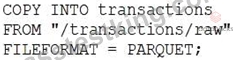
After running the command today, the data engineer notices that the number of records in table transactions has not changed.
Which of the following describes why the statement might not have copied any new records into the table?
- A. The previous day's file has already been copied into the table.
- B. The names of the files to be copied were not included with the FILES keyword.
- C. The format of the files to be copied were not included with the FORMAT_OPTIONS keyword.
- D. The COPY INTO statement requires the table to be refreshed to view the copied rows.
- E. The PARQUET file format does not support COPY INTO.
Answer: A
Explanation:
The COPY INTO statement is an idempotent operation, which means that it will skip any files that have already been loaded into the target table1. This ensures that the data is not duplicated or corrupted by multiple attempts to load the same file. Therefore, if the data engineer runs the same command every day without specifying the names of the files to be copied with the FILES keyword or a glob pattern with the PATTERN keyword, the statement will only copy the first file that matches the source location and ignore the rest. To avoid this problem, the data engineer should either use the FILES or PATTERN keywords to filter the files to be copied based on the date or some other criteria, or delete the files from the source location after they are copied into the table2. References: 1: COPY INTO | Databricks on AWS 2: Get started using COPY INTO to load data | Databricks on AWS
NEW QUESTION # 55
A data engineer has been using a Databricks SQL dashboard to monitor the cleanliness of the input data to a data analytics dashboard for a retail use case. The job has a Databricks SQL query that returns the number of store-level records where sales is equal to zero. The data engineer wants their entire team to be notified via a messaging webhook whenever this value is greater than 0.
Which of the following approaches can the data engineer use to notify their entire team via a messaging webhook whenever the number of stores with $0 in sales is greater than zero?
- A. They can set up an Alert with a new webhook alert destination.
- B. They can set up an Alert with a custom template.
- C. They can set up an Alert without notifications.
- D. They can set up an Alert with a new email alert destination.
- E. They can set up an Alert with one-time notifications.
Answer: A
Explanation:
A webhook alert destination is a notification destination that allows Databricks to send HTTP POST requests to a third-party endpoint when an alert is triggered. This enables the data engineer to integrate Databricks alerts with their preferred messaging or collaboration platform, such as Slack, Microsoft Teams, or PagerDuty.
To set up a webhook alert destination, the data engineer needs to create and configure a webhook connector in their messaging platform, and then add the webhook URL to the Databricks notification destination. After that, the data engineer can create an alert for their Databricks SQL query, and select the webhook alert destination as the notification destination. The alert can be configured with a custom condition, such as when the number of stores with $0 in sales is greater than zero, and a custom message template, such as "Alert:{number_of_stores} stores have $0 in sales". The alert can also be configured with a recurrence interval, such as every hour, to check the query result periodically. When the alert condition is met, the data engineer and their team will receive a notification via the messaging webhook, with the custom message and a link to the Databricks SQL query. The other options are either not suitable for sending notifications via a messaging webhook (A, B, E), or not suitable for sending recurring notifications.
References: Databricks Documentation - Manage notification destinations, Databricks Documentation - Create alerts for Databricks SQL queries, Databricks Documentation - Configure alert conditions and messages.
NEW QUESTION # 56
Which of the following must be specified when creating a new Delta Live Tables pipeline?
- A. The preferred DBU/hour cost
- B. At least one notebook library to be executed
- C. A key-value pair configuration
- D. A path to cloud storage location for the written data
- E. A location of a target database for the written data
Answer: B
Explanation:
Option E is the correct answer because it is the only mandatory requirement when creating a new Delta Live Tables pipeline. A pipeline is a data processing workflow that contains materialized views and streaming tables declared in Python or SQL source files. Delta Live Tables infers the dependencies between these tables and ensures updates occur in the correct order. To create a pipeline, you need to specify at least one notebook library to be executed, which contains the Delta Live Tables syntax. You can also specify multiple libraries of different languages within your pipeline. The other options are optional or not applicable for creating a pipeline. Option A is not required, but you can optionally provide a key-value pair configuration to customize the pipeline settings, such as the storage location, the target schema, the notifications, and the pipeline mode. Option B is not applicable, as the DBU/hour cost is determined by the cluster configuration, not the pipeline creation. Option C is not required, but you can optionally specify a storage location for the output data from the pipeline. If you leave it empty, the system uses a default location. Option D is not required, but you can optionally specify a location of a target database for the written data, either in the Hive metastore or the Unity Catalog.
NEW QUESTION # 57
A new data engineering team team has been assigned to an ELT project. The new data engineering team will need full privileges on the table sales to fully manage the project.
Which command can be used to grant full permissions on the database to the new data engineering team?
- A. GRANT SELECT CREATE MODIFY ON TABLE sales TO team;
- B. GRANT SELECT ON TABLE sales TO team;
- C. GRANT ALL PRIVILEGES ON TABLE team TO sales;
- D. grant all privileges on table sales TO team;
Answer: D
Explanation:
To grant full privileges on a table such as 'sales' to a group like 'team', the correct SQL command in Databricks is:
GRANT ALL PRIVILEGES ON TABLE sales TO team;
This command assigns all available privileges, including SELECT, INSERT, UPDATE, DELETE, and any other data manipulation or definition actions, to the specified team. This is typically necessary when a team needs full control over a table to manage and manipulate it as part of a project or ongoing maintenance.
Reference:
Databricks documentation on SQL permissions: SQL Permissions in Databricks
NEW QUESTION # 58
Which of the following commands can be used to write data into a Delta table while avoiding the writing of duplicate records?
- A. DROP
- B. APPEND
- C. INSERT
- D. MERGE
- E. IGNORE
Answer: D
NEW QUESTION # 59
Which of the following code blocks will remove the rows where the value in column age is greater than 25 from the existing Delta table my_table and save the updated table?
- A. UPDATE my_table WHERE age > 25;
- B. DELETE FROM my_table WHERE age > 25;
- C. SELECT * FROM my_table WHERE age > 25;
- D. UPDATE my_table WHERE age <= 25;
- E. DELETE FROM my_table WHERE age <= 25;
Answer: B
Explanation:
The DELETE command in Delta Lake allows you to remove data that matches a predicate from a Delta table.
This command will delete all the rows where the value in the column age is greater than 25 from the existing Delta table my_table and save the updated table. The other options are either incorrect or do not achieve the desired result. Option A will only select the rows that match the predicate, but not delete them. Option B will update the rows that match the predicate, but not delete them. Option D will update the rows that do not match the predicate, but not delete them. Option E will delete the rows that do not match the predicate, which is the opposite of what we want. References: Table deletes, updates, and merges - Delta Lake Documentation
NEW QUESTION # 60
Which of the following statements regarding the relationship between Silver tables and Bronze tables is always true?
- A. Silver tables contain more data than Bronze tables.
- B. Silver tables contain less data than Bronze tables.
- C. Silver tables contain a more refined and cleaner view of data than Bronze tables.
- D. Silver tables contain a less refined, less clean view of data than Bronze data.
- E. Silver tables contain aggregates while Bronze data is unaggregated.
Answer: A
Explanation:
Explanation
https://www.databricks.com/glossary/medallion-architecture
NEW QUESTION # 61
A data engineer wants to create a relational object by pulling data from two tables. The relational object does not need to be used by other data engineers in other sessions. In order to save on storage costs, the data engineer wants to avoid copying and storing physical data.
Which of the following relational objects should the data engineer create?
- A. Spark SQL Table
- B. Temporary view
- C. Database
- D. Delta Table
- E. View
Answer: B
Explanation:
Explanation
Temp view : session based Create temp view view_name as query All these are termed as session ended:
Opening a new notebook Detaching and reattaching a cluster Installing a python package Restarting a cluster
NEW QUESTION # 62
A data organization leader is upset about the data analysis team's reports being different from the data engineering team's reports. The leader believes the siloed nature of their organization's data engineering and data analysis architectures is to blame.
Which of the following describes how a data lakehouse could alleviate this issue?
- A. Both teams would be able to collaborate on projects in real-time
- B. Both teams would respond more quickly to ad-hoc requests
- C. Both teams would reorganize to report to the same department
- D. Both teams would autoscale their work as data size evolves
- E. Both teams would use the same source of truth for their work
Answer: E
Explanation:
A data lakehouse is a data management architecture that combines the flexibility, cost-efficiency, and scale of data lakes with the data management and ACID transactions of data warehouses, enabling business intelligence (BI) and machine learning (ML) on all data12. By using a data lakehouse, both the data analysis and data engineering teams can access the same data sources and formats, ensuring data consistency and quality across their reports. A data lakehouse also supports schema enforcement and evolution, data validation, and time travel to old table versions, which can help resolve data conflicts and errors1. Reference: 1: What is a Data Lakehouse? - Databricks 2: What is a data lakehouse? | IBM
NEW QUESTION # 63
Which of the following can be used to simplify and unify siloed data architectures that are specialized for specific use cases?
- A. None of these
- B. Data lake
- C. Data lakehouse
- D. All of these
- E. Data warehouse
Answer: C
Explanation:
A data lakehouse is a new paradigm that can be used to simplify and unify siloed data architectures that are specialized for specific use cases. A data lakehouse combines the best of both data lakes and data warehouses, providing a single platform that supports diverse data types, open standards, low-cost storage, high-performance queries, ACID transactions, schema enforcement, and governance. A data lakehouse enables data engineers to build reliable and scalable data pipelines that can serve various downstream applications and users, such as data science, machine learning, analytics, and reporting. A data lakehouse leverages the power of Delta Lake, a storage layer that brings reliability and performance to data lakes. References: What is a data lakehouse?, Delta Lake, Lakehouse: A New Generation of Open Platforms that Unify Data Warehousing and Advanced Analytics
NEW QUESTION # 64
Which of the following SQL keywords can be used to convert a table from a long format to a wide format?
- A. WHERE
- B. SUM
- C. PIVOT
- D. TRANSFORM
- E. CONVERT
Answer: C
Explanation:
The SQL keyword that can be used to convert a table from a long format to a wide format is PIVOT. The PIVOT clause is used to rotate the rows of a table into columns of a new table1. The PIVOT clause can aggregate the values of a column based on the distinct values of another column, and use those values as the column names of the new table1. The PIVOT clause can be useful for transforming data from a long format, where each row represents an observation with multiple attributes, to a wide format, where each row represents an observation with a single attribute and multiple values2. For example, the PIVOT clause can be used to convert a table that contains the sales of different products by different regions into a table that contains the sales of each product by each region as separate columns1.
The other options are not suitable for converting a table from a long format to a wide format. CONVERT is a function that can be used to change the data type of an expression3. WHERE is a clause that can be used to filter the rows of a table based on a condition4. TRANSFORM is a keyword that can be used to apply a user-defined function to a group of rows in a table5. SUM is a function that can be used to calculate the total of a numeric column.
References:
* 1: PIVOT | Databricks on AWS
* 2: Reshaping Data - Long vs Wide Format | Databricks on AWS
* 3: CONVERT | Databricks on AWS
* 4: WHERE | Databricks on AWS
* 5: TRANSFORM | Databricks on AWS
* : [SUM | Databricks on AWS]
NEW QUESTION # 65
A data architect has determined that a table of the following format is necessary:
Which of the following code blocks uses SQL DDL commands to create an empty Delta table in the above format regardless of whether a table already exists with this name?
- A. Option C
- B. Option E
- C. Option A
- D. Option B
- E. Option D
Answer: B
NEW QUESTION # 66
A data engineer wants to create a relational object by pulling data from two tables. The relational object does not need to be used by other data engineers in other sessions. In order to save on storage costs, the data engineer wants to avoid copying and storing physical data.
Which of the following relational objects should the data engineer create?
- A. Spark SQL Table
- B. Temporary view
- C. Database
- D. Delta Table
- E. View
Answer: B
Explanation:
A temporary view is a relational object that is defined in the metastore and points to an existing DataFrame. It does not copy or store any physical data, but only saves the query that defines the view. The lifetime of a temporary view is tied to the SparkSession that was used to create it, so it does not persist across different sessions or applications. A temporary view is useful for accessing the same data multiple times within the same notebook or session, without incurring additional storage costs. The other options are either materialized (A, E), persistent (B, C), or not relational objects. References: Databricks Documentation - Temporary View, Databricks Community - How do temp views actually work?, Databricks Community - What's the difference between a Global view and a Temp view?, Big Data Programmers - Temporary View in Databricks.
NEW QUESTION # 67
A data engineer has a Python notebook in Databricks, but they need to use SQL to accomplish a specific task within a cell. They still want all of the other cells to use Python without making any changes to those cells.
Which of the following describes how the data engineer can use SQL within a cell of their Python notebook?
- A. They can change the default language of the notebook to SQL
- B. They can simply write SQL syntax in the cell
- C. It is not possible to use SQL in a Python notebook
- D. They can add %sql to the first line of the cell
- E. They can attach the cell to a SQL endpoint rather than a Databricks cluster
Answer: D
Explanation:
In Databricks, you can use different languages within the same notebook by using magic commands. Magic commands are special commands that start with a percentage sign (%) and allow you to change the behavior of the cell. To use SQL within a cell of a Python notebook, you can add %sql to the first line of the cell. This will tell Databricks to interpret the rest of the cell as SQL code and execute it against the default database. You can also specify a different database by using the USE statement. The result of the SQL query will be displayed as a table or a chart, depending on the output mode. You can also assign the result to a Python variable by using the -o option. For example, %sql -o df SELECT * FROM my_table will run the SQL query and store the result as a pandas DataFrame in the Python variable df. Option A is incorrect, as it is possible to use SQL in a Python notebook using magic commands. Option B is incorrect, as attaching the cell to a SQL endpoint is not necessary and will not change the language of the cell. Option C is incorrect, as simply writing SQL syntax in the cell will result in a syntax error, as the cell will still be interpreted as Python code. Option E is incorrect, as changing the default language of the notebook to SQL will affect all the cells, not just one. Reference: Use SQL in Notebooks - Knowledge Base - Noteable, [SQL magic commands - Databricks], [Databricks SQL Guide - Databricks]
NEW QUESTION # 68
Which of the following Structured Streaming queries is performing a hop from a Silver table to a Gold table?
- A.
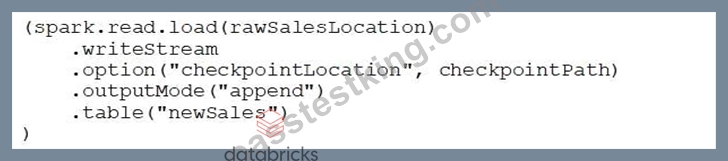
- B.
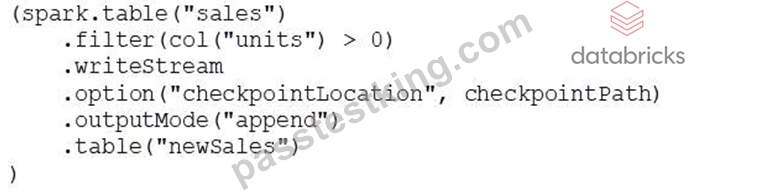
- C.
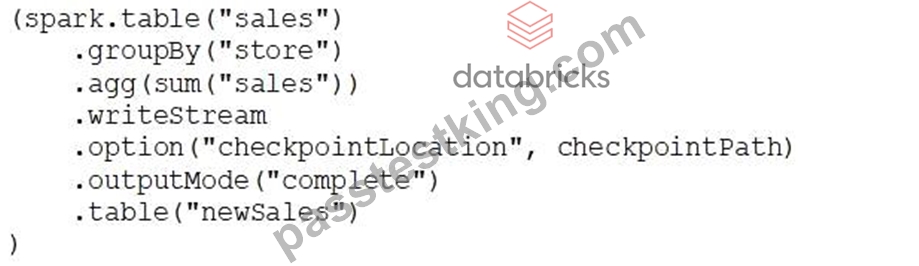
- D.
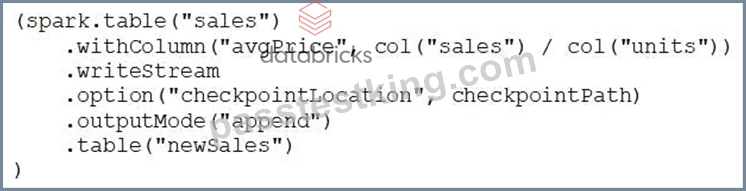
- E.
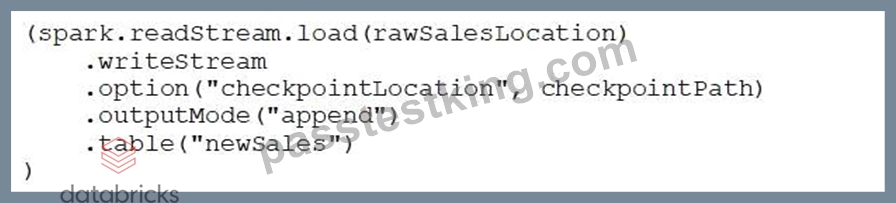
Answer: C
NEW QUESTION # 69
A dataset has been defined using Delta Live Tables and includes an expectations clause:
CONSTRAINT valid_timestamp EXPECT (timestamp > '2020-01-01') ON VIOLATION DROP ROW What is the expected behavior when a batch of data containing data that violates these constraints is processed?
- A. Records that violate the expectation are added to the target dataset and flagged as invalid in a field added to the target dataset.
- B. Records that violate the expectation are dropped from the target dataset and loaded into a quarantine table.
- C. Records that violate the expectation are dropped from the target dataset and recorded as invalid in the event log.
- D. Records that violate the expectation are added to the target dataset and recorded as invalid in the event log.
- E. Records that violate the expectation cause the job to fail.
Answer: C
Explanation:
Delta Live Tables expectations are optional clauses that apply data quality checks on each record passing through a query. An expectation consists of a description, a boolean statement, and an action to take when a record fails the expectation. The ON VIOLATION clause specifies the action to take, which can be one of the following: warn, drop, or fail. The drop action means that invalid records are dropped from the target dataset before data is written to the target. The failure is reported as a metric for the dataset, which can be viewed by querying the Delta Live Tables event log. The event log contains information such as the number of records that violate an expectation, the number of records dropped, and the number of records written to the target dataset. References:
* Manage data quality with Delta Live Tables
* Monitor Delta Live Tables pipelines
* Delta Live Tables SQL language reference
NEW QUESTION # 70
A data engineer wants to create a data entity from a couple of tables. The data entity must be used by other data engineers in other sessions. It also must be saved to a physical location.
Which of the following data entities should the data engineer create?
- A. Database
- B. Table
- C. View
- D. Temporary view
- E. Function
Answer: B
Explanation:
A table is a data entity that is stored in a physical location and can be accessed by other data engineers in other sessions. A table can be created from one or more tables using the CREATE TABLE or CREATE TABLE AS SELECT commands. A table can also be registered from an existing DataFrame using the spark.catalog.createTable method. A table can be queried using SQL or DataFrame APIs. A table can also be updated, deleted, or appended using the MERGE INTO command or the DeltaTable API. References:
* Create a table
* Create a table from a query result
* Register a table from a DataFrame
* [Query a table]
* [Update, delete, or merge into a table]
NEW QUESTION # 71
A data engineer has three tables in a Delta Live Tables (DLT) pipeline. They have configured the pipeline to drop invalid records at each table. They notice that some data is being dropped due to quality concerns at some point in the DLT pipeline. They would like to determine at which table in their pipeline the data is being dropped.
Which of the following approaches can the data engineer take to identify the table that is dropping the records?
- A. They can navigate to the DLT pipeline page, click on the "Error" button, and review the present errors.
- B. They can set up DLT to notify them via email when records are dropped.
- C. They can navigate to the DLT pipeline page, click on each table, and view the data quality statistics.
- D. They can set up separate expectations for each table when developing their DLT pipeline.
- E. They cannot determine which table is dropping the records.
Answer: C
Explanation:
Explanation
To identify the table in a Delta Live Tables (DLT) pipeline where data is being dropped due to quality concerns, the data engineer can navigate to the DLT pipeline page, click on each table in the pipeline, and view the data quality statistics. These statistics often include information about records dropped, violations of expectations, and other data quality metrics. By examining the data quality statistics for each table in the pipeline, the data engineer can determine at which table the data is being dropped.
NEW QUESTION # 72
A data engineer wants to schedule their Databricks SQL dashboard to refresh every hour, but they only want the associated SQL endpoint to be running when It is necessary. The dashboard has multiple queries on multiple datasets associated with it. The data that feeds the dashboard is automatically processed using a Databricks Job.
Which approach can the data engineer use to minimize the total running time of the SQL endpoint used in the refresh schedule of their dashboard?
- A. Q They can turn on the Auto Stop feature for the SQL endpoint.
- B. O They can reduce the cluster size of the SQL endpoint.
- C. O They can set up the dashboard's SQL endpoint to be serverless.
- D. 0 They can ensure the dashboard's SQL endpoint matches each of the queries' SQL endpoints.
Answer: A
Explanation:
To minimize the total running time of the SQL endpoint used in the refresh schedule of a dashboard in Databricks, the most effective approach is to utilize the Auto Stop feature. This feature allows the SQL endpoint to automatically stop after a period of inactivity, ensuring that it only runs when necessary, such as during the dashboard refresh or when actively queried. This minimizes resource usage and associated costs by ensuring the SQL endpoint is not running idle outside of these operations.
Reference:
Databricks documentation on SQL endpoints: SQL Endpoints in Databricks
NEW QUESTION # 73
A data engineer needs to create a table in Databricks using data from their organization's existing SQLite database.
They run the following command: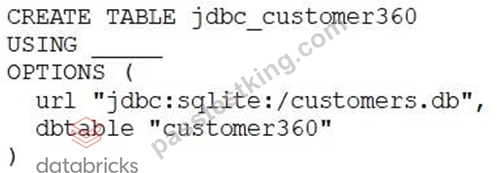
Which of the following lines of code fills in the above blank to successfully complete the task?
- A. autoloader
- B. org.apache.spark.sql.jdbc
- C. DELTA
- D. org.apache.spark.sql.sqlite
- E. sqlite
Answer: D
NEW QUESTION # 74
A data engineer needs to create a table in Databricks using data from their organization's existing SQLite database.
They run the following command:
Which of the following lines of code fills in the above blank to successfully complete the task?
- A. autoloader
- B. org.apache.spark.sql.jdbc
- C. DELTA
- D. sqlite
- E. org.apache.spark.sql.sqlite
Answer: D
Explanation:
1: In the given command, a data engineer is trying to create a table in Databricks using data from an SQLite database. The correct option to fill in the blank is "sqlite" because it specifies the type of database being connected to in a JDBC connection string. The USING clause should be followed by the format of the data, and since we are connecting to an SQLite database, "sqlite" would be appropriate here. Reference:
Create a table using JDBC
JDBC connection string
SQLite JDBC driver
NEW QUESTION # 75
An engineering manager uses a Databricks SQL query to monitor ingestion latency for each data source. The manager checks the results of the query every day, but they are manually rerunning the query each day and waiting for the results.
Which of the following approaches can the manager use to ensure the results of the query are updated each day?
- A. They can schedule the query to refresh every 12 hours from the SQL endpoint's page in Databricks SQL.
- B. They can schedule the query to refresh every 1 day from the query's page in Databricks SQL.
- C. They can schedule the query to run every 1 day from the Jobs UI.
- D. They can schedule the query to run every 12 hours from the Jobs UI.
- E. They can schedule the query to refresh every 1 day from the SQL endpoint's page in Databricks SQL.
Answer: B
NEW QUESTION # 76
......
Passing Key To Getting Databricks-Certified-Data-Engineer-Associate Certified Exam Engine PDF: https://www.passtestking.com/Databricks/Databricks-Certified-Data-Engineer-Associate-practice-exam-dumps.html
Databricks-Certified-Data-Engineer-Associate Exam Dumps Pass with Updated Tests Dumps: https://drive.google.com/open?id=1NNOP5XRhdO0Y8sBq-NgcQZZFgF9mItJr