

2023 100% Free DP-100 Daily Practice Exam With 266 Questions
DP-100 exam torrent Microsoft study guide
Exam DP-100: Designing and Implementing a Data Science Solution on Azure
Candidates for the Azure Data Scientist Associate certification should have subject matter expertise applying data science and machine learning to implement and run machine learning workloads on Azure.
Responsibilities for this role include planning and creating a suitable working environment for data science workloads on Azure. You run data experiments and train predictive models. In addition, you manage, optimize, and deploy machine learning models into production.
A candidate for this certification should have knowledge and experience in data science and using Azure Machine Learning and Azure Databricks.
Part of the requirements for: Microsoft Certified: Azure Data Scientist Associate
NEW QUESTION 41
You need to modify the inputs for the global penalty event model to address the bias and variance issue.
Which three actions should you perform in sequence? To answer, move the appropriate actions from the list of actions to the answer area and arrange them in the correct order.
Answer:
Explanation:
NEW QUESTION 42
You need to correct the model fit issue.
Which three actions should you perform in sequence? To answer, move the appropriate actions from the list of actions to the answer area and arrange them in the correct order.
Answer:
Explanation:
Explanation:
Step 1: Augment the data
Scenario: Columns in each dataset contain missing and null values. The datasets also contain many outliers.
Step 2: Add the Bayesian Linear Regression module.
Scenario: You produce a regression model to predict property prices by using the Linear Regression and Bayesian Linear Regression modules.
Step 3: Configure the regularization weight.
Regularization typically is used to avoid overfitting. For example, in L2 regularization weight, type the value to use as the weight for L2 regularization. We recommend that you use a non-zero value to avoid overfitting.
Scenario:
Model fit: The model shows signs of overfitting. You need to produce a more refined regression model that reduces the overfitting.
Incorrect Answers:
Multiclass Decision Jungle module:
Decision jungles are a recent extension to decision forests. A decision jungle consists of an ensemble of decision directed acyclic graphs (DAGs).
L-BFGS:
L-BFGS stands for "limited memory Broyden-Fletcher-Goldfarb-Shanno". It can be found in the wwo-Class Logistic Regression module, which is used to create a logistic regression model that can be used to predict two (and only two) outcomes.
References:
<https://docs.microsoft.com/en-us/azure/machine-learning/studio-module-reference/linear-regr ession>
NEW QUESTION 43
Your team is building a data engineering and data science development environment.
The environment must support the following requirements:
* support Python and Scala
* compose data storage, movement, and processing services into automated data pipelines
* the same tool should be used for the orchestration of both data engineering and data science
* support workload isolation and interactive workloads
* enable scaling across a cluster of machines
You need to create the environment.
What should you do?
- A. Build the environment in Apache Spark for HDInsight and use Azure Container Instances for orchestration.
- B. Build the environment in Azure Databricks and use Azure Data Factory for orchestration.
- C. Build the environment in Azure Databricks and use Azure Container Instances for orchestration.
- D. Build the environment in Apache Hive for HDInsight and use Azure Data Factory for orchestration.
Answer: B
Explanation:
Explanation
In Azure Databricks, we can create two different types of clusters.
* Standard, these are the default clusters and can be used with Python, R, Scala and SQL
* High-concurrency
Azure Databricks is fully integrated with Azure Data Factory.
NEW QUESTION 44
You are producing a multiple linear regression model in Azure Machine Learning Studio.
Several independent variables are highly correlated.
You need to select appropriate methods for conducting effective feature engineering on all the data.
Which three actions should you perform in sequence? To answer, move the appropriate actions from the list of actions to the answer area and arrange them in the correct order.
Answer:
Explanation:
Explanation:
Step 1: Use the Filter Based Feature Selection module
Filter Based Feature Selection identifies the features in a dataset with the greatest predictive power.
The module outputs a dataset that contains the best feature columns, as ranked by predictive power. It also outputs the names of the features and their scores from the selected metric.
Step 2: Build a counting transform
A counting transform creates a transformation that turns count tables into features, so that you can apply the transformation to multiple datasets.
Step 3: Test the hypothesis using t-Test
References:
https://docs.microsoft.com/bs-latn-ba/azure/machine-learning/studio-module-reference/filter-based-feature-selection
https://docs.microsoft.com/en-us/azure/machine-learning/studio-module-reference/build-counting-transform
NEW QUESTION 45 
For each of the following statements, select Yes if the statement is true. Otherwise, select No. NOTE: Each correct selection is worth one point.
Answer:
Explanation:
NEW QUESTION 46
A coworker registers a datastore in a Machine Learning services workspace by using the following code:
You need to write code to access the datastore from a notebook.
Answer:
Explanation:
Explanation:
Box 1: DataStore
To get a specific datastore registered in the current workspace, use the get() static method on the Datastore class:
# Get a named datastore from the current workspace
datastore = Datastore.get(ws, datastore_name='your datastore name')
Box 2: ws
Box 3: demo_datastore
Reference:
https://docs.microsoft.com/en-us/azure/machine-learning/how-to-access-data
NEW QUESTION 47
You are running a training experiment on remote compute in Azure Machine Learning.
The experiment is configured to use a conda environment that includes the mlflow and azureml-contrib-run packages.
You must use MLflow as the logging package for tracking metrics generated in the experiment.
You need to complete the script for the experiment.
How should you complete the code? To answer, select the appropriate options in the answer area.
NOTE: Each correct selection is worth one point.
Answer:
Explanation:
Reference:
https://docs.microsoft.com/en-us/azure/machine-learning/how-to-use-mlflow
NEW QUESTION 48
You are analyzing the asymmetry in a statistical distribution.
The following image contains two density curves that show the probability distribution of two datasets.
Use the drop-down menus to select the answer choice that answers each question based on the information presented in the graphic.
NOTE: Each correct selection is worth one point.
Answer:
Explanation:
Explanation
Box 1: Positive skew
Positive skew values means the distribution is skewed to the right.
Box 2: Negative skew
Negative skewness values mean the distribution is skewed to the left.
References:
https://docs.microsoft.com/en-us/azure/machine-learning/studio-module-reference/compute-elementary-statistics
NEW QUESTION 49
You use Data Science Virtual Machines (DSVMs) for Windows and Linux in Azure.
You need to access the DSVMs.
Which utilities should you use? To answer, select the appropriate options in the answer area.
NOTE: Each correct selection is worth one point.
Answer:
Explanation:
NEW QUESTION 50
You publish a batch inferencing pipeline that will be used by a business application.
The application developers need to know which information should be submitted to and returned by the REST interface for the published pipeline.
You need to identify the information required in the REST request and returned as a response from the published pipeline.
Which values should you use in the REST request and to expect in the response? To answer, select the appropriate options in the answer area.
NOTE: Each correct selection is worth one point.
Answer:
Explanation:
Explanation:
Box 1: JSON containing an OAuth bearer token
Specify your authentication header in the request.
To run the pipeline from the REST endpoint, you need an OAuth2 Bearer-type authentication header.
Box 2: JSON containing the experiment name
Add a JSON payload object that has the experiment name.
Example:
rest_endpoint = published_pipeline.endpoint
response = requests.post(rest_endpoint,
headers=auth_header,
json={"ExperimentName": "batch_scoring",
"ParameterAssignments": {"process_count_per_node": 6}})
run_id = response.json()["Id"]
Box 3: JSON containing the run ID
Make the request to trigger the run. Include code to access the Id key from the response dictionary to get the value of the run ID.
Reference:
https://docs.microsoft.com/en-us/azure/machine-learning/tutorial-pipeline-batch-scoring-classification
NEW QUESTION 51
You plan to preprocess text from CSV files. You load the Azure Machine Learning Studio default stop words list.
You need to configure the Preprocess Text module to meet the following requirements:
* Ensure that multiple related words from a single canonical form.
* Remove pipe characters from text.
* Remove words to optimize information retrieval.
Which three options should you select? To answer, select the appropriate options in the answer area.
NOTE: Each correct selection is worth one point.
Answer:
Explanation:
Explanation:
Box 1: Remove stop words
Remove words to optimize information retrieval.
Remove stop words: Select this option if you want to apply a predefined stopword list to the text column. Stop word removal is performed before any other processes.
Box 2: Lemmatization
Ensure that multiple related words from a single canonical form.
Lemmatization converts multiple related words to a single canonical form Box 3: Remove special characters Remove special characters: Use this option to replace any non-alphanumeric special characters with the pipe | character.
References:
https://docs.microsoft.com/en-us/azure/machine-learning/studio-module-reference/preprocess-text
Topic 1, Case Study
Overview
You are a data scientist in a company that provides data science for professional sporting events. Models will be global and local market data to meet the following business goals:
* Understand sentiment of mobile device users at sporting events based on audio from crowd reactions.
* Access a user's tendency to respond to an advertisement.
* Customize styles of ads served on mobile devices.
* Use video to detect penalty events.
Current environment
Requirements
* Media used for penalty event detection will be provided by consumer devices. Media may include images and videos captured during the sporting event and snared using social media. The images and videos will have varying sizes and formats.
* The data available for model building comprises of seven years of sporting event media. The sporting event media includes: recorded videos, transcripts of radio commentary, and logs from related social media feeds feeds captured during the sporting events.
* Crowd sentiment will include audio recordings submitted by event attendees in both mono and stereo Formats.
Advertisements
* Ad response models must be trained at the beginning of each event and applied during the sporting event.
* Market segmentation nxxlels must optimize for similar ad resporr.r history.
* Sampling must guarantee mutual and collective exclusivity local and global segmentation models that share the same features.
* Local market segmentation models will be applied before determining a user's propensity to respond to an advertisement.
* Data scientists must be able to detect model degradation and decay.
* Ad response models must support non linear boundaries features.
* The ad propensity model uses a cut threshold is 0.45 and retrains occur if weighted Kappa deviates from 0.1 +/-5%.
* The ad propensity model uses cost factors shown in the following diagram:
The ad propensity model uses proposed cost factors shown in the following diagram:
Performance curves of current and proposed cost factor scenarios are shown in the following diagram: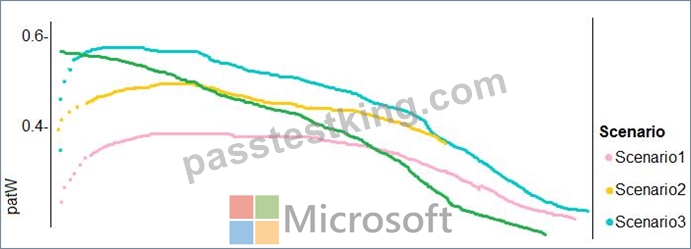
Penalty detection and sentiment
Findings
* Data scientists must build an intelligent solution by using multiple machine learning models for penalty event detection.
* Data scientists must build notebooks in a local environment using automatic feature engineering and model building in machine learning pipelines.
* Notebooks must be deployed to retrain by using Spark instances with dynamic worker allocation
* Notebooks must execute with the same code on new Spark instances to recode only the source of the data.
* Global penalty detection models must be trained by using dynamic runtime graph computation during training.
* Local penalty detection models must be written by using BrainScript.
* Experiments for local crowd sentiment models must combine local penalty detection data.
* Crowd sentiment models must identify known sounds such as cheers and known catch phrases. Individual crowd sentiment models will detect similar sounds.
* All shared features for local models are continuous variables.
* Shared features must use double precision. Subsequent layers must have aggregate running mean and standard deviation metrics Available.
segments
During the initial weeks in production, the following was observed:
* Ad response rates declined.
* Drops were not consistent across ad styles.
* The distribution of features across training and production data are not consistent.
Analysis shows that of the 100 numeric features on user location and behavior, the 47 features that come from location sources are being used as raw features. A suggested experiment to remedy the bias and variance issue is to engineer 10 linearly uncorrected features.
Penalty detection and sentiment
* Initial data discovery shows a wide range of densities of target states in training data used for crowd sentiment models.
* All penalty detection models show inference phases using a Stochastic Gradient Descent (SGD) are running too stow.
* Audio samples show that the length of a catch phrase varies between 25%-47%, depending on region.
* The performance of the global penalty detection models show lower variance but higher bias when comparing training and validation sets. Before implementing any feature changes, you must confirm the bias and variance using all training and validation cases.
NEW QUESTION 52
You are using the Azure Machine Learning Service to automate hyper par a meter exploration of your neural network classification model.
You must define the hyper parameter space to automatically tune hyper parameters using random sampling according to following requirements:
* Learning rate must be selected from a normal distribution with a mean value of 10 and a standard deviation of 3.
* Batch size must be 16, 32 and 64.
* Keep probability must be a value selected from a uniform distribution between the range of 0.05 and 0.1.
You need to use the par am .sampling method of the Python API for the Azure Machine Learning Service.
How should you complete the code segment? To answer, select the appropriate Options in the answer area.
NOTE: Each correct selection is worth one point.
Answer:
Explanation:
NEW QUESTION 53
You create a batch inference pipeline by using the Azure ML SDK. You run the pipeline by using the following code:
from azureml.pipeline.core import Pipeline
from azureml.core.experiment import Experiment
pipeline = Pipeline(workspace=ws, steps=[parallelrun_step])
pipeline_run = Experiment(ws, 'batch_pipeline').submit(pipeline)
You need to monitor the progress of the pipeline execution.
What are two possible ways to achieve this goal? Each correct answer presents a complete solution.
NOTE: Each correct selection is worth one point.
- A. Option E
- B. Option C
- C. Option B
- D. Option A
- E. Option D
Answer: A,E
Explanation:
A batch inference job can take a long time to finish. This example monitors progress by using a Jupyter widget. You can also manage the job's progress by using:
* Azure Machine Learning Studio.
* Console output from the PipelineRun object.
from azureml.widgets import RunDetails
RunDetails(pipeline_run).show()
pipeline_run.wait_for_completion(show_output=True)
Reference:
https://docs.microsoft.com/en-us/azure/machine-learning/how-to-use-parallel-run-step#monitor-the-parallel-run-job
NEW QUESTION 54
You need to visually identify whether outliers exist in the Age column and quantify the outliers before the outliers are removed.
Which three Azure Machine Learning Studio modules should you use in sequence? To answer, move the appropriate modules from the list of modules to the answer area and arrange them in the correct order.
Create Scatterplot
Summarize Data
Clip Values
You can use the Clip Values module in Azure Machine Learning Studio, to identify and optionally replace data values that are above or below a specified threshold. This is useful when you want to remove outliers or replace them with a mean, a constant, or other substitute value.
Answer:
Explanation:
References:
https://blogs.msdn.microsoft.com/azuredev/2017/05/27/data-cleansing-tools-in-azure-machine-learning/
https://docs.microsoft.com/en-us/azure/machine-learning/studio-module-reference/clip-values
NEW QUESTION 55
You use the Azure Machine Learning designer to create and run a training pipeline.
The pipeline must be run every night to inference predictions from a large volume of files. The folder where the files will be stored is defined as a dataset.
You need to publish the pipeline as a REST service that can be used for the nightly inferencing run.
What should you do?
- A. Create a real-time inference pipeline
- B. Clone the pipeline
- C. Create a batch inference pipeline
- D. Set the compute target for the pipeline to an inference cluster
Answer: C
Explanation:
Azure Machine Learning Batch Inference targets large inference jobs that are not time-sensitive. Batch Inference provides cost-effective inference compute scaling, with unparalleled throughput for asynchronous applications. It is optimized for high-throughput, fire-and-forget inference over large collections of data.
You can submit a batch inference job by pipeline_run, or through REST calls with a published pipeline.
Reference:
https://github.com/Azure/MachineLearningNotebooks/blob/master/how-to-use-azureml/machine-learning-pipelines/parallel-run/README.md
NEW QUESTION 56
You train and register a model by using the Azure Machine Learning SDK on a local workstation. Python 3.6 and Visual Studio Code are installed on the workstation.
When you try to deploy the model into production as an Azure Kubernetes Service (AKS)-based web service, you experience an error in the scoring script that causes deployment to fail.
You need to debug the service on the local workstation before deploying the service to production.
Which four actions should you perform in sequence? To answer, move the appropriate actions from the list of actions to the answer area and arrange them in the correct order.
Answer:
Explanation:
1 - Install Docker on the workstation
2 - Create an AksWebservice deployment configuration and deploy the model to it
3 - Create a LocalWebservice deployment configuration for the service and deploy the model to it
4 - Debug and modify the scoring script as necessary. Use the reload() method of the service after each modification.
Reference:
https://docs.microsoft.com/en-us/azure/machine-learning/how-to-deploy-azure-kubernetes-service
https://docs.microsoft.com/en-us/azure/machine-learning/how-to-troubleshoot-deployment-local
NEW QUESTION 57
Note: This question is part of a series of questions that present the same scenario. Each question in the series contains a unique solution that might meet the stated goals. Some question sets might have more than one correct solution, while others might not have a correct solution.
After you answer a question in this section, you will NOT be able to return to it. As a result, these questions will not appear in the review screen.
An IT department creates the following Azure resource groups and resources:
The IT department creates an Azure Kubernetes Service (AKS)-based inference compute target named aks-cluster in the Azure Machine Learning workspace.
You have a Microsoft Surface Book computer with a GPU. Python 3.6 and Visual Studio Code are installed.
You need to run a script that trains a deep neural network (DNN) model and logs the loss and accuracy metrics.
Solution: Install the Azure ML SDK on the Surface Book. Run Python code to connect to the workspace and then run the training script as an experiment on local compute.
- A. No
- B. Yes
Answer: A
Explanation:
Explanation
Need to attach the mlvm virtual machine as a compute target in the Azure Machine Learning workspace.
Reference:
https://docs.microsoft.com/en-us/azure/machine-learning/concept-compute-target
NEW QUESTION 58
You define a datastore named ml-data for an Azure Storage blob container. In the container, you have a folder named train that contains a file named data.csv. You plan to use the file to train a model by using the Azure Machine Learning SDK.
You plan to train the model by using the Azure Machine Learning SDK to run an experiment on local compute.
You define a DataReference object by running the following code:
You need to load the training data.
Which code segment should you use?
- A.

- B.

- C.

- D.

- E.

Answer: E
Explanation:
Example:
data_folder = args.data_folder
# Load Train and Test data
train_data = pd.read_csv(os.path.join(data_folder, 'data.csv'))
Reference:
https://www.element61.be/en/resource/azure-machine-learning-services-complete-toolbox-ai
NEW QUESTION 59
You are analyzing the asymmetry in a statistical distribution.
The following image contains two density curves that show the probability distribution of two datasets.
Use the drop-down menus to select the answer choice that answers each question based on the information presented in the graphic.
NOTE: Each correct selection is worth one point.
Answer:
Explanation:
Explanation:
Box 1: Positive skew
Positive skew values means the distribution is skewed to the right.
Box 2: Negative skew
Negative skewness values mean the distribution is skewed to the left.
References:
https://docs.microsoft.com/en-us/azure/machine-learning/studio-module-reference/compute-elementary-statistics
NEW QUESTION 60
Note: This question is part of a series of questions that present the same scenario. Each question in the series contains a unique solution that might meet the stated goals. Some question sets might have more than one correct solution, while others might not have a correct solution.
After you answer a question in this section, you will NOT be able to return to it. As a result, these questions will not appear in the review screen.
You create an Azure Machine Learning service datastore in a workspace. The datastore contains the following files:
* /data/2018/Q1.csv
* /data/2018/Q2.csv
* /data/2018/Q3.csv
* /data/2018/Q4.csv
* /data/2019/Q1.csv
All files store data in the following format:
id,f1,f2i
1,1.2,0
2,1,1,
1 3,2.1,0
You run the following code:
You need to create a dataset named training_data and load the data from all files into a single data frame by using the following code:
Solution: Run the following code:
Does the solution meet the goal?
- A. No
- B. Yes
Answer: A
Explanation:
Use two file paths.
Use Dataset.Tabular_from_delimeted, instead of Dataset.File.from_files as the data isn't cleansed.
Reference:
https://docs.microsoft.com/en-us/azure/machine-learning/how-to-create-register-datasets
NEW QUESTION 61
You are performing sentiment analysis using a CSV file that includes 12,000 customer reviews written in a short sentence format. You add the CSV file to Azure Machine Learning Studio and configure it as the starting point dataset of an experiment. You add the Extract N-Gram Features from Text module to the experiment to extract key phrases from the customer review column in the dataset.
You must create a new n-gram dictionary from the customer review text and set the maximum n-gram size to trigrams.
What should you select? To answer, select the appropriate options in the answer area.
NOTE: Each correct selection is worth one point.
Answer:
Explanation:
Explanation

Vocabulary mode: Create
For Vocabulary mode, select Create to indicate that you are creating a new list of n-gram features.
N-Grams size: 3
For N-Grams size, type a number that indicates the maximum size of the n-grams to extract and store. For example, if you type 3, unigrams, bigrams, and trigrams will be created.
Weighting function: Leave blank
The option, Weighting function, is required only if you merge or update vocabularies. It specifies how terms in the two vocabularies and their scores should be weighted against each other.
References:
https://docs.microsoft.com/en-us/azure/machine-learning/studio-module-reference/extract-n-gram-features-from-
NEW QUESTION 62
......
Use Valid New DP-100 Test Notes & DP-100 Valid Exam Guide: https://www.passtestking.com/Microsoft/DP-100-practice-exam-dumps.html
DP-100 Actual Questions Answers PDF 100% Cover Real Exam Questions: https://drive.google.com/open?id=1eMClHLGgHid0yaqzzBqwayt9RFd_vRIS