

[May-2023] SAP Certified Application Associate C_HANAIMP_18 Exam Practice Test Questions Dumps Bundle!
2023 Updated C_HANAIMP_18 PDF for the C_HANAIMP_18 Tests Free Updated Today!
C_HANAIMP_18 Exam Certification Details:
| Cut Score: | 64% |
| Sample Questions: | SAP C_HANAIMP_18 Exam Sample Question |
| Level: | Associate |
| Duration: | 180 mins |
| Languages: | English |
The SAP HANA 2.0 SPS06 certification exam covers a wide range of topics, including database architecture, data modeling, data provisioning, security, and performance optimization. The exam is suitable for professionals who have experience in SAP HANA database administration, data modeling, or application development.
NEW QUESTION # 32
Which calendar types can be selected when creating time-based DIMENSIONS?Note: There are 2 correct answers to this question.
- A. Factory
- B. Fiscal
- C. Julian
- D. Gregorian
Answer: B,D
NEW QUESTION # 33
What is the SQL keyword used to process input parameters defined in a calculation view?
- A. Where
- B. Set
- C. Placeholder
- D. Hint
Answer: C
NEW QUESTION # 34
In SAP Web IDE, you rename a dimension calculation view that is used by a cube calculation view. You do NOT use the option to rename the runtime view and adjust the reference. Afterward, you perform the following build operations:Build the dimension calculation view as a single object.Build the entire SAP HANA database module.What is the outcome of the build operations?
- A. The first build is successful.The second build is successful.
- B. The first build is successful.The second build fails.
- C. The first build fails.The second build is successful.
- D. The first build fails.The second build fails.
Answer: A
NEW QUESTION # 35
Two calculation views, A and B, are defined as shown in the diagram. Three analytic privileges have been granted to you.When you preview calculation view A, what data do you see?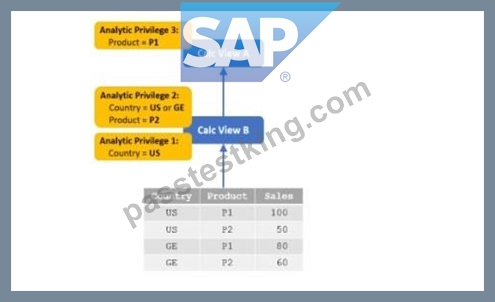
- A. US for P1 and GE for P1
- B. US for P1 and P2, and GE for P2
- C. US for P1
- D. US for P1 and P2, and GE for P1 and P2
Answer: C
NEW QUESTION # 36
Which of the following are standard options provided to define analytic privileges?Note: There are 3 correct answers to this question.
- A. Graph
- B. Hierarchy function
- C. Dynamic
- D. Attributes
- E. SQL expression
Answer: C,D,E
NEW QUESTION # 37
You are managing your source files using Git. In which sequence does your file progress towards a COMMIT?
- A. Staging area -> Working directory -> Local Git repository
- B. Local Git repository -> Staging area -> Working directory
- C. Working directory -> Local Git repository -> Staging area
- D. Working directory -> Staging area -> Local Git repository
Answer: D
NEW QUESTION # 38
Which type of join supports a temporal condition in a calculation view?
- A. Referential join
- B. Text join
- C. Left outer join
- D. Inner join
Answer: D
NEW QUESTION # 39
Which tool generates and executes the SQL for a specific node of your calculation view?
- A. SQL analyzer
- B. Database explorer
- C. Explain plan
- D. Debug Query mode
Answer: D
NEW QUESTION # 40
Why would you enable Debug Query mode in a calculation view?
- A. To identify data sources that are not accessed by a query
- B. To check which database engines are invoked
- C. To understand how tables are partitioned
- D. To set breakpoints and step through the execution
Answer: A
NEW QUESTION # 41
Why do you use the Hidden Columns checkbox in the semantics node of your calculation view?Note: There are 2 correct answers to this question.
- A. To ensure specific columns are NOT exposed to the reporting tool
- B. To remove a column that is also used as a Label column
- C. To avoid exposing sensitive columns when defining calculated columns
- D. To prevent passing columns in stacked calculation views
Answer: A,B
NEW QUESTION # 42
You combine two tables in a join node using multiple columns in each table.Why do you enable the dynamic join option?Note: There are 2 correct answers to this question.
- A. To ensure that the aggregation always happens after the join execution
- B. To force the calculation at the relevant level of granularity, even if this level is not the grouping level defined by the query
- C. To ensure that the join execution only uses the join columns requested in the query
- D. To allow data analysis at different levels of granularity with the same calculation view
Answer: C,D
NEW QUESTION # 43
In an XS Advanced project, what is the purpose of the .hdiconfig file?
- A. To specify the namespace rules applicable to the name of database objects
- B. To specify which HDI plug-ins are available
- C. To specify an external schema in which calculation views will get their data
- D. To specify in which space the container should be deployed
Answer: B
NEW QUESTION # 44
You create a table function to remove historic records, sum the current total weekly working hours for each employee, and update the personnel table with the results. The deployment of the table function fails.Which of the following could be a valid reason?
- A. Your function refers to a scalar function.
- B. You did NOT define a valid table type.
- C. Your function includes a TRUNCATE statement.
- D. You did not define at least one input parameter.
Answer: C
NEW QUESTION # 45
Which of the following are warm data tier solutions?Note: There are 3 correct answers to this question.
- A. Dynamic Tiering
- B. Active / active read-enabled mode
- C. Persistent memory
- D. Extension Node
- E. Native Storage Extension
Answer: A,D,E
NEW QUESTION # 46
What is generated when you deploy a CUBE calculation view design-time file?Note: There are 2 correct answers to this question.
- A. Cached results to improve read performance
- B. A column view in a container
- C. An SQL execution plan
- D. Metadata to enable consumption by external tools
Answer: B,D
NEW QUESTION # 47
You implement a referential join between Table A and Table B, but when you query the calculation view, Table B is not pruned.What could be the problem?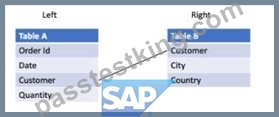
Note: There are 2 correct answers to this question.
- A. The Keep flag is activated for the Customer column.
- B. Integrity constraint is set to RIGHT.
- C. The Country column is requested.
- D. Join cardinality is set :1.
Answer: A,B
NEW QUESTION # 48
What can you do with shared hierarchies?Note: There are 2 correct answers to this question.
- A. Provide reusable hierarchies for drilldown in a CUBE without star join
- B. Access hierarchies created in external schemas
- C. Provide reusable hierarchies for drilldown in a CUBE with star join
- D. Enable SQL SELECT statements to access hierarchies
Answer: C,D
NEW QUESTION # 49
Which of the following supports data replication?
- A. SAP HANA smart data quality
- B. SAP HANA, streaming analytics option
- C. SAP HANA smart data integration
- D. SAP HANA smart data access
Answer: C
NEW QUESTION # 50
What can you identify using Performance Analysis mode?Note: There are 2 correct answers to this question.
- A. Expected memory consumption
- B. Usage statistics of the calculation view
- C. Information about join cardinality
- D. Joins that are defined on calculated columns
Answer: C,D
NEW QUESTION # 51
Why might you use the Keep Flag property in an aggregation node?
- A. To include columns that are NOT requested by a query but are essential for the correct result
- B. To retain the correct aggregation behavior in stacked views
- C. To exclude columns that are NOT requested by a query to avoid incorrect results
- D. To ensure that the aggregation behavior defined in the aggregation node for a measure CANNOT be overridden by a query
Answer: A
NEW QUESTION # 52
You define a hierarchy in a calculation view. You want to expose the hierarchy to SQL Which of the following conditions must be met?Note: There are 2 correct answers to this question.
- A. The hierarchy must be a local hierarchy.
- B. The hierarchy must be exposed by a calculation view of type CUBE with star join.
- C. The hierarchy must be defined in a calculation view of type SQL ACCESS ONLY.
- D. The hierarchy must be a shared hierarchy.
Answer: B,D
NEW QUESTION # 53
......
Fully Updated Dumps PDF - Latest C_HANAIMP_18 Exam Questions and Answers: https://www.passtestking.com/SAP/C_HANAIMP_18-practice-exam-dumps.html
100% Free C_HANAIMP_18 Exam Dumps to Pass Exam Easily: https://drive.google.com/open?id=1siQV-woaCEfYr9nh9L1HnzGtJfqG7XHK