

Dependable DP-203 Exam Dumps to Become Microsoft Certified
Get Ready with DP-203 Exam Dumps (2026)
Microsoft DP-203 exam is suitable for those who have experience with Microsoft Azure and want to specialize in data engineering. DP-203 exam covers a wide range of topics such as data processing, data storage, data transformation, and data integration. It tests the candidate's ability to design, implement, and monitor data processing solutions on Azure.
NEW QUESTION # 116
You have the following table named Employees.
You need to calculate the employee_type value based on the hire_date value.
How should you complete the Transact-SQL statement? To answer, drag the appropriate values to the correct targets. Each value may be used once, more than once, or not at all. You may need to drag the split bar between panes or scroll to view content.
NOTE: Each correct selection is worth one point.
Answer:
Explanation:
Reference:
https://docs.microsoft.com/en-us/sql/t-sql/language-elements/case-transact-sql
NEW QUESTION # 117
You need to design the partitions for the product sales transactions. The solution must meet the sales transaction dataset requirements.
What should you include in the solution? To answer, select the appropriate options in the answer area.
NOTE: Each correct selection is worth one point.
Answer:
Explanation:
Explanation
Box 1: Sales date
Scenario: Contoso requirements for data integration include:
Partition data that contains sales transaction records. Partitions must be designed to provide efficient loads by month. Boundary values must belong to the partition on the right.
Box 2: An Azure Synapse Analytics Dedicated SQL pool
Scenario: Contoso requirements for data integration include:
Ensure that data storage costs and performance are predictable.
The size of a dedicated SQL pool (formerly SQL DW) is determined by Data Warehousing Units (DWU).
Dedicated SQL pool (formerly SQL DW) stores data in relational tables with columnar storage. This format significantly reduces the data storage costs, and improves query performance.
Synapse analytics dedicated sql pool
Reference:
https://docs.microsoft.com/en-us/azure/synapse-analytics/sql-data-warehouse/sql-data-warehouse-overview-wha
NEW QUESTION # 118
You have an Azure Active Directory (Azure AD) tenant that contains a security group named Group1. You have an Azure Synapse Analytics dedicated SQL pool named dw1 that contains a schema named schema1.
You need to grant Group1 read-only permissions to all the tables and views in schema1. The solution must use the principle of least privilege.
Which three actions should you perform in sequence? To answer, move the appropriate actions from the list of actions to the answer area and arrange them in the correct order.
NOTE: More than one order of answer choices is correct. You will receive credit for any of the correct orders you select.
Answer:
Explanation:
Reference:
https://docs.microsoft.com/en-us/azure/data-share/how-to-share-from-sql
NEW QUESTION # 119
You have an Azure data factory named ADM that contains a pipeline named Pipelwe1 Pipeline! must execute every 30 minutes with a 15-minute offset.
Vou need to create a trigger for Pipehne1. The trigger must meet the following requirements:
* Backfill data from the beginning of the day to the current time.
* If Pipeline1 fairs, ensure that the pipeline can re-execute within the same 30-mmute period.
* Ensure that only one concurrent pipeline execution can occur.
* Minimize de4velopment and configuration effort
Which type of trigger should you create?
- A. event-based
- B. schedule
- C. manual
- D. tumbling window
Answer: D
NEW QUESTION # 120
You use Azure Data Factory to prepare data to be queried by Azure Synapse Analytics serverless SQL pools.
Files are initially ingested into an Azure Data Lake Storage Gen2 account as 10 small JSON files. Each file contains the same data attributes and data from a subsidiary of your company.
You need to move the files to a different folder and transform the data to meet the following requirements:
* Provide the fastest possible query times.
* Automatically infer the schema from the underlying files.
How should you configure the Data Factory copy activity? To answer, select the appropriate options in the answer area.
NOTE: Each correct selection is worth one point.
Answer:
Explanation:
Explanation
Box 1: Preserver herarchy
Compared to the flat namespace on Blob storage, the hierarchical namespace greatly improves the performance of directory management operations, which improves overall job performance.
Box 2: Parquet
Azure Data Factory parquet format is supported for Azure Data Lake Storage Gen2.
Parquet supports the schema property.
Reference:
https://docs.microsoft.com/en-us/azure/storage/blobs/data-lake-storage-introduction
https://docs.microsoft.com/en-us/azure/data-factory/format-parquet
NEW QUESTION # 121
You have an Azure subscription that contains an Azure Data Lake Storage account. The storage account contains a data lake named DataLake1.
You plan to use an Azure data factory to ingest data from a folder in DataLake1, transform the data, and land the data in another folder.
You need to ensure that the data factory can read and write data from any folder in the DataLake1 file system.
The solution must meet the following requirements:
Minimize the risk of unauthorized user access.
Use the principle of least privilege.
Minimize maintenance effort.
How should you configure access to the storage account for the data factory? To answer, select the appropriate options in the answer area.
NOTE: Each correct selection is worth one point.
Answer:
Explanation:
Explanation:
Box 1: Azure Active Directory (Azure AD)
On Azure, managed identities eliminate the need for developers having to manage credentials by providing an identity for the Azure resource in Azure AD and using it to obtain Azure Active Directory (Azure AD) tokens.
Box 2: a managed identity
A data factory can be associated with a managed identity for Azure resources, which represents this specific data factory. You can directly use this managed identity for Data Lake Storage Gen2 authentication, similar to using your own service principal. It allows this designated factory to access and copy data to or from your Data Lake Storage Gen2.
Note: The Azure Data Lake Storage Gen2 connector supports the following authentication types.
Account key authentication
Service principal authentication
Managed identities for Azure resources authentication
Reference:
https://docs.microsoft.com/en-us/azure/active-directory/managed-identities-azure-resources/overview
https://docs.microsoft.com/en-us/azure/data-factory/connector-azure-data-lake-storage
NEW QUESTION # 122
You have an Azure Databricks workspace that contains a Delta Lake dimension table named Tablet. Table1 is a Type 2 slowly changing dimension (SCD) table. You need to apply updates from a source table to Table1.
Which Apache Spark SQL operation should you use?
- A. ALTER
- B. UPDATE
- C. CREATE
- D. MERGE
Answer: D
Explanation:
Explanation
The Delta provides the ability to infer the schema for data input which further reduces the effort required in managing the schema changes. The Slowly Changing Data(SCD) Type 2 records all the changes made to each key in the dimensional table. These operations require updating the existing rows to mark the previous values of the keys as old and then inserting new rows as the latest values. Also, Given a source table with the updates and the target table with dimensional data, SCD Type 2 can be expressed with the merge.
Example:
// Implementing SCD Type 2 operation using merge function
customersTable
as("customers")
merge(
stagedUpdates.as("staged_updates"),
"customers.customerId = mergeKey")
whenMatched("customers.current = true AND customers.address <> staged_updates.address") updateExpr(Map(
"current" -> "false",
"endDate" -> "staged_updates.effectiveDate"))
whenNotMatched()
insertExpr(Map(
"customerid" -> "staged_updates.customerId",
"address" -> "staged_updates.address",
"current" -> "true",
"effectiveDate" -> "staged_updates.effectiveDate",
"endDate" -> "null"))
execute()
}
Reference:
https://www.projectpro.io/recipes/what-is-slowly-changing-data-scd-type-2-operation-delta-table-databricks
NEW QUESTION # 123
You have a Microsoft Purview account. The Lineage view of a CSV file is shown in the following exhibit.
How is the data for the lineage populated?
- A. by scanning data stores
- B. by executing a Data Factory pipeline
- C. manually
Answer: A
Explanation:
Explanation
According to Microsoft Purview Data Catalog lineage user guide , data lineage in Microsoft Purview is a core platform capability that populates the Microsoft Purview Data Map with data movement and transformations across systems2. Lineage is captured as it flows in the enterprise and stitched without gaps irrespective of its source2.
NEW QUESTION # 124
You have an Azure Synapse Analytics workspace named WS1.
You have an Azure Data Lake Storage Gen2 container that contains JSON-formatted files in the following format.
You need to use the serverless SQL pool in WS1 to read the files.
How should you complete the Transact-SQL statement? To answer, drag the appropriate values to the correct targets. Each value may be used once, more than once, or not at all. You may need to drag the split bar between panes or scroll to view content.
NOTE: Each correct selection is worth one point.
Answer:
Explanation:
Explanation: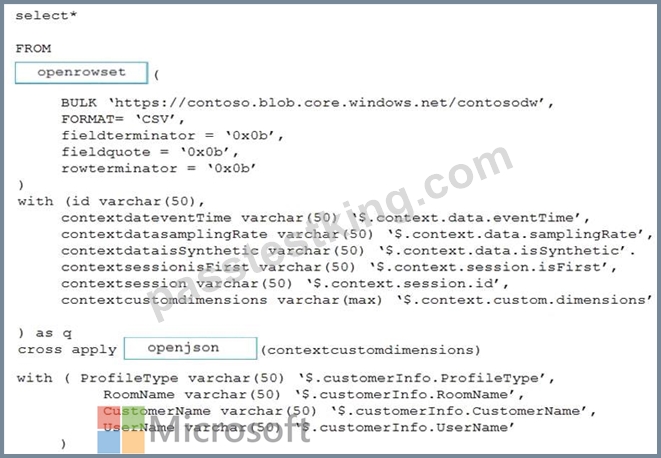
Box 1: openrowset
The easiest way to see to the content of your CSV file is to provide file URL to OPENROWSET function, specify csv FORMAT.
Example:
SELECT *
FROM OPENROWSET(
BULK 'csv/population/population.csv',
DATA_SOURCE = 'SqlOnDemandDemo',
FORMAT = 'CSV', PARSER_VERSION = '2.0',
FIELDTERMINATOR =',',
ROWTERMINATOR = '\n'
Box 2: openjson
You can access your JSON files from the Azure File Storage share by using the mapped drive, as shown in the following example:
SELECT book.* FROM
OPENROWSET(BULK N't:\books\books.json', SINGLE_CLOB) AS json
CROSS APPLY OPENJSON(BulkColumn)
WITH( id nvarchar(100), name nvarchar(100), price float,
pages_i int, author nvarchar(100)) AS book
Reference:
https://docs.microsoft.com/en-us/azure/synapse-analytics/sql/query-single-csv-file
https://docs.microsoft.com/en-us/sql/relational-databases/json/import-json-documents-into-sql-server
NEW QUESTION # 125
Vou have an Azure Synapse Analytics dedicated SQL pool.
You need to create a copy of the data warehouse and make the copy available for 28 days. The solution must minimize costs.
Which three actions should you perform in sequence? To answer, move the appropriate actions from the list of actions to the answer area and arrange them in the correct order.
Answer:
Explanation:
NEW QUESTION # 126
You are creating dimensions for a data warehouse in an Azure Synapse Analytics dedicated SQL pool.
You create a table by using the Transact-SQL statement shown in the following exhibit.
Use the drop-down menus to select the answer choice that completes each statement based on the information presented in the graphic.
NOTE: Each correct selection is worth one point.
Answer:
Explanation:
Explanation
Box 1: Type 2
A Type 2 SCD supports versioning of dimension members. Often the source system doesn't store versions, so the data warehouse load process detects and manages changes in a dimension table. In this case, the dimension table must use a surrogate key to provide a unique reference to a version of the dimension member. It also includes columns that define the date range validity of the version (for example, StartDate and EndDate) and possibly a flag column (for example, IsCurrent) to easily filter by current dimension members.
Reference:
https://docs.microsoft.com/en-us/learn/modules/populate-slowly-changing-dimensions-azure-synapse-analytics-p
NEW QUESTION # 127
You use PySpark in Azure Databricks to parse the following JSON input.
You need to output the data in the following tabular format.
How should you complete the PySpark code? To answer, drag the appropriate values to he correct targets. Each value may be used once, more than once or not at all. You may need to drag the split bar between panes or scroll to view content.
NOTE: Each correct selection is worth one point.
Answer:
Explanation:
NEW QUESTION # 128
You are creating an Azure Data Factory data flow that will ingest data from a CSV file, cast columns to specified types of data, and insert the data into a table in an Azure Synapse Analytic dedicated SQL pool. The CSV file contains three columns named username, comment, and date.
The data flow already contains the following:
A source transformation.
A Derived Column transformation to set the appropriate types of data.
A sink transformation to land the data in the pool.
You need to ensure that the data flow meets the following requirements:
All valid rows must be written to the destination table.
Truncation errors in the comment column must be avoided proactively.
Any rows containing comment values that will cause truncation errors upon insert must be written to a file in blob storage.
Which two actions should you perform? Each correct answer presents part of the solution.
NOTE: Each correct selection is worth one point.
- A. To the data flow, add a sink transformation to write the rows to a file in blob storage.
- B. To the data flow, add a Conditional Split transformation to separate the rows that will cause truncationerrors.
- C. To the data flow, add a filter transformation to filter out rows that will cause truncation errors.
- D. Add a select transformation to select only the rows that will cause truncation errors.
Answer: A,B
Explanation:
B: Example:
1. This conditional split transformation defines the maximum length of "title" to be five. Any row that is less than or equal to five will go into the GoodRows stream. Any row that is larger than five will go into the BadRows stream.
2. This conditional split transformation defines the maximum length of "title" to be five. Any row that is less than or equal to five will go into the GoodRows stream. Any row that is larger than five will go into the BadRows stream.
A:
3. Now we need to log the rows that failed. Add a sink transformation to the BadRows stream for logging.
Here, we'll "auto-map" all of the fields so that we have logging of the complete transaction record. This is a text-delimited CSV file output to a single file in Blob Storage. We'll call the log file "badrows.csv".
4. The completed data flow is shown below. We are now able to split off error rows to avoid the SQL truncation errors and put those entries into a log file. Meanwhile, successful rows can continue to write to our target database.
Reference:
https://docs.microsoft.com/en-us/azure/data-factory/how-to-data-flow-error-rows
NEW QUESTION # 129
You have an Azure Data Lake Storage Gen2 account that contains a JSON file for customers. The file contains two attributes named FirstName and LastName.
You need to copy the data from the JSON file to an Azure Synapse Analytics table by using Azure Databricks. A new column must be created that concatenates the FirstName and LastName values.
You create the following components:
* A destination table in Azure Synapse
* An Azure Blob storage container
* A service principal
Which five actions should you perform in sequence next in is Databricks notebook? To answer, move the appropriate actions from the list of actions to the answer area and arrange them in the correct order.
Answer:
Explanation:
Explanation:
1) mount onto DBFS
2) read into data frame
3) transform data frame
4) specify temporary folder
5) write the results to table in in Azure Synapse
https://docs.databricks.com/data/data-sources/azure/azure-datalake-gen2.html https://docs.microsoft.com/en-us
/azure/databricks/scenarios/databricks-extract-load-sql-data-warehouse
NEW QUESTION # 130
You are building an Azure Synapse Analytics dedicated SQL pool that will contain a fact table for transactions from the first half of the year 2020.
You need to ensure that the table meets the following requirements:
Minimizes the processing time to delete data that is older than 10 years Minimizes the I/O for queries that use year-to-date values How should you complete the Transact-SQL statement? To answer, select the appropriate options in the answer area.
NOTE: Each correct selection is worth one point.
Answer:
Explanation:
Reference:
https://docs.microsoft.com/en-us/sql/t-sql/statements/create-partition-function-transact-sql
NEW QUESTION # 131
......
Microsoft DP-203 (Data Engineering on Microsoft Azure) certification exam is designed for professionals who want to validate their skills in designing and implementing data solutions on Microsoft Azure. Data Engineering on Microsoft Azure certification exam measures your ability to work with different Azure data services like Azure Data Factory, Azure Stream Analytics, Azure Databricks, and more. As a data engineer, you will learn how to use these tools to transform raw data into meaningful insights that can help organizations make better decisions.
Download Exam DP-203 Practice Test Questions with 100% Verified Answers: https://www.passtestking.com/Microsoft/DP-203-practice-exam-dumps.html
Realistic DP-203 Dumps are Available for Instant Access: https://drive.google.com/open?id=1-re0pjDrTFwn0Z9CjLLkwkyFor3xIARv