

2025 The Most Effective Scripting-and-Programming-Foundations with 140 Questions Answers
Try Free and Start Using Realistic Verified Scripting-and-Programming-Foundations Dumps Instantly.
NEW QUESTION # 22 
What is put to output by calling Greeting() twice
- A. Hello!
- B. Hello!Hello!
- C. Hello!
Answer: B
Explanation:
The output of calling Greeting() twice depends on the implementation of the Greeting() function. Since the question does not provide the actual code for Greeting(), I'll provide a general explanation.
* If the Greeting() function simply prints "Hello!" without any additional characters or spaces, then calling it twice would result in the output: "Hello!Hello!" (Option B).
* If the Greeting() function prints "Hello!" followed by a newline character (or any other separator), then calling it twice would result in the output: "Hello!\nHello!" (where \n represents the newline character).
* If the Greeting() function prints "Hello!" with a space after it, then calling it twice would result in the output: "Hello! Hello!".
Without the actual implementation of Greeting(), we cannot definitively determine the exact output. However, the most common interpretation would be Option B: Hello!Hello!.
References
* Scripting and Programming Foundations documents.
NEW QUESTION # 23
What is the loop variable update statement in the following code?
- A. Integer j = -1
- B. J = j + 3
- C. Put j to output
- D. J < 24
Answer: B
Explanation:
The loop variable update statement is responsible for changing the loop variable's value after each iteration of the loop, ensuring that the loop progresses and eventually terminates. In the options provided, J = j + 3 is the statement that updates the loop variable j by adding 3 to its current value. This is a typical update statement found in loops, particularly in 'for' or 'while' loops, where the loop variable needs to be changed systematically to avoid infinite loops.
References: This understanding of loop variable update statements is based on fundamental programming concepts that are taught in introductory programming courses and documented in programming language specifications1234. These principles are applied consistently across various programming languages.
NEW QUESTION # 24
Which value would require an integer as a data type?
- A. The weights of every patient involved in a pharmaceutical
- B. The number of students in a section
- C. An approximation of the number pi to five decimal places
- D. The cost of a dinner including tax and tip
Answer: B
Explanation:
An integer data type is used to represent whole numbers without any fractional or decimal component. In the given options:
* A. The number of students in a section is a countable quantity that does not require a fractional part, making it suitable for an integer data type.
* B. The cost of a dinner including tax and tip would typically involve a decimal to account for cents, thus requiring a floating-point data type.
* C. The weights of patients are usually measured with precision and can have decimal values, necessitating a floating-point data type.
* D. An approximation of the number pi to five decimal places is a decimal value and would require a floating-point data type.
NEW QUESTION # 25
A program calculates the average miles per gallon given miles traveled and gas consumed How should the item that holds me miles per gallon be declared?
- A. Constant float milesTraveled
- B. Constant float milesPerGallon
- C. Variable float milesTraveled
- D. Variable float milesPerGallon
Answer: D
Explanation:
In a program that calculates the average miles per gallon based on miles traveled and gas consumed, the item that holds the miles per gallon should be declared as a variable because it will change depending on the input values. The data type should be a floating-point number (float) because miles per gallon is a value that can have a fractional part, and it is not a fixed value, hence it should not be a constant.
References:
* Best practices in programming suggest using variables for values that change and constants for values that remain the same throughout the program execution.
* The concept of variables and data types is fundamental in programming and is covered in foundational programming documentation and textbooks.
NEW QUESTION # 26
Which data type should be used to hold the value of a person's body temperature in Fahrenheit
- A. String
- B. Float
- C. Integer
- D. Boolean
Answer: B
Explanation:
When dealing with body temperature, especially in Fahrenheit, the appropriate data type to use is a floating-point number (float). Here's why:
* Measurement Precision:
* Body temperature can have decimal values, such as 98.6°F.
* Integer data types (like B. Integer) cannot represent fractional values.
* Floats allow for greater precision and can handle decimal places.
* Temperature Scales:
* Fahrenheit is a continuous scale, not a discrete set of values.
* It includes both positive and negative values (e.g., sub-zero temperatures).
* Floats accommodate this range effectively.
* Examples:
* A person's body temperature might be 98.6°F (normal) or 101.3°F (fever).
* These values require a data type that can handle fractions.
* References:
* The normal body temperature varies across different measurement sites (e.g., rectal, tympanic, oral, axillary) but falls within a range. For example:
* Rectal: 36.32-37.76°C (97.38-99.97°F)
* Tympanic: 35.76-37.52°C (96.37-99.54°F)
* Axillary: 35.01-36.93°C (95.02-98.47°F)1
* Using a float allows us to represent these variations accurately.
Remember that using a float ensures flexibility and precision when dealing with temperature measurements.
Therefore, the correct answer is D. Float.
NEW QUESTION # 27
What is the outcome for the given algorithm? Round to the nearest tenth, if necessary.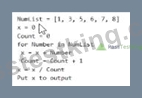
- A. 5.0
- B. 8.4
- C. 6.1
- D. 6.0
Answer: A
Explanation:
* Initialize two variables: x and Count to zero.
* Iterate through each number in the NumList.
* For each number in the list:
* Add the number to x.
* Increment Count by one.
* After processing all numbers in the list, calculate the average:
* Average = x / Count.
The NumList contains the following integers: [1, 3, 5, 6, 7, 8].
Calculating the average: (1 + 3 + 5 + 6 + 7 + 8) / 6 = 30 / 6 = 5.0.
However, none of the provided options match this result. It seems there might be an error in either the options or the calculation.
References: This explanation is based on understanding and analyzing the provided algorithm image; no external references are used.
NEW QUESTION # 28
What is a feature of CM as a programming language
- A. The code does not require being translated into machine code but can be run by a separate program called a compiler.
- B. The code runs directly one statement at a time by another program called a compiler
- C. The code must be compiled into machine code in the form of an executable file before execution.
- D. The program usually runs slower than an interpreted language.
Answer: C
Explanation:
The C(M) programming language is designed to translate mathematical constructions into efficient C programs. It is a declarative functional language with strong type checking and supports high-level functional programming. The C(M) compiler translates the C(M) program into a readable C program, which then needs to be compiled into machine code in the form of an executable file before it can be executed1. This process is typical of compiled languages, where the source code is transformed into machine code, which can be directly executed by the computer's CPU. In contrast, interpreted languages are typically run by an interpreter, executing one statement at a time, which generally results in slower execution compared to compiled languages.
NEW QUESTION # 29
A function should determine the average of x and y.
What should be the function's parameters and return value(s)?
- A. Parameters: x, yReturn value: average
- B. Parameters: nonsReturn values: x, y
- C. Parameters: averageReturn values: x, y
- D. Parameters: x, y. averageReturn value: none
Answer: A
Explanation:
In programming, a function that calculates the average of two numbers will require both numbers as input to perform the calculation. These inputs are known as parameters. Once the function has completed its calculation, it should return the result. In this case, the result is the average of the two numbers, which is the return value.
Here's a simple example in pseudocode:
function calculateAverage(x, y) {
average = (x + y) / 2
return average
}
In this function, x and y are the parameters, and the average is the calculated value that the function returns after execution.
References:
* Parameters and return values are fundamental concepts in programming that allow functions to receive inputs and return outputs12.
* The syntax and structure of function parameters and return values are consistent across many programming languages, ensuring that a function can perform operations using the provided inputs and then return a result2.
NEW QUESTION # 30
A program calculates the average miles per gallon given miles traveled and gas consumed. How should the item that holds the miles per gallon be declared?
- A. Constant float milesTraveled
- B. Constant float milesPerGallon
- C. Variable float milesTraveled
- D. Variable float milesPerGallon
Answer: D
Explanation:
Comprehensive and Detailed Explanation From Exact Extract:
Miles per gallon (MPG) is calculated as miles traveled divided by gallons consumed, typically resulting in a decimal value (e.g., 25.5 MPG). According to foundational programming principles, MPG should be a variable (as it is computed and may change) and a floating-point type to handle decimals.
* Option A: "Variable float milesTraveled." This is incorrect. While miles traveled may be a float variable, the question asks for the declaration of MPG, not miles traveled.
* Option B: "Constant float milesPerGallon." This is incorrect. MPG is calculated and may vary with different inputs, so it should be a variable, not a constant (const).
* Option C: "Constant float milesTraveled." This is incorrect. The question focuses on MPG, not miles traveled, and constants are inappropriate for computed values.
* Option D: "Variable float milesPerGallon." This is correct. MPG requires a float to store decimal values (e.g., 22.7) and a variable to allow updates based on new calculations. For example, in C: float milesPerGallon = miles / gallons;.
Certiport Scripting and Programming Foundations Study Guide (Section on Variables and Data Types).
Python Documentation: "Floating Point Arithmetic" (https://docs.python.org/3/tutorial/floatingpoint.html).
W3Schools: "C Data Types" (https://www.w3schools.com/c/c_data_types.php).
NEW QUESTION # 31
Which term refers to a function that represents the number of fixed-size memory units used for an input of a given size?
- A. Runtime
- B. Computational complexity
- C. Linear search
- D. Space complexity
Answer: D
Explanation:
Space complexity refers to the amount of memory space required by an algorithm in relation to the size of the input data. It is a function, often denoted as S(N), that represents the number of fixed-size memory units used by the algorithm for an input of size N. For example, if an algorithm needs to create a new array that is the same size as the input array, its space complexity would be linear, or O(N), where N is the size of the input array. This term is crucial in evaluating the efficiency of an algorithm, especially when working with large data sets or in systems with limited memory resources.
References: The definition and explanation of space complexity can be found in various educational resources and literature on data structures and algorithms, such as computer science textbooks and online educational platforms12.
NEW QUESTION # 32
A function determines the least common multiple (LCM) of two positive integers (a and b). What should be the input to the function?
- A. a * b
- B. L only
- C. a and b
- D. a and L
Answer: C
Explanation:
Comprehensive and Detailed Explanation From Exact Extract:
The least common multiple (LCM) of two positive integers a and b is the smallest number that is a multiple of both. A function to compute the LCM requires a and b as inputs to perform the calculation (e.g., using the formula LCM(a, b) = (a * b) / GCD(a, b), where GCD is the greatest common divisor). According to foundational programming principles, the function's inputs must include all values needed to compute the output.
* Task Analysis:
* Goal: Compute LCM of a and b.
* Required inputs: The two integers a and b.
* Output: The LCM (denoted as L in the question).
* Option A: "L only." This is incorrect. L is the output (the LCM), not an input. The function needs a and b to calculate L.
* Option B: "a * b." This is incorrect. The product a * b is used in the LCM formula (LCM = (a * b) / GCD(a, b)), but the function needs a and b separately to compute the GCD and then the LCM.
* Option C: "a and L." This is incorrect. L is the output, not an input, and the function does not need L to compute itself.
* Option D: "a and b." This is correct. The function requires the two integers a and b as inputs to compute their LCM. For example, in Python:
def lcm(a, b):
def gcd(x, y):
while y:
x, y = y, x % y
return x
return (a * b) // gcd(a, b)
Certiport Scripting and Programming Foundations Study Guide (Section on Functions and Parameters).
Cormen, T.H., et al., Introduction to Algorithms, 3rd Edition (Chapter 31: Number-Theoretic Algorithms).
GeeksforGeeks: "LCM of Two Numbers" (https://www.geeksforgeeks.org/lcm-of-two-numbers/).
NEW QUESTION # 33
Consider the given function.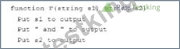
What is the total output when F (sign, horse) is called 2 times?
- A. sign and horse sign and horse
- B. sign and horse and sign and horse
- C. sign and horse sign and horse
- D. sign and horse sign and horse
Answer: D
Explanation:
The provided code defines a function named F that takes two strings si and l2 as input. However, there seems to be a typo in the variable names (si instead of sign and l2 instead of horse).
Inside the function:
* Put sl to output: This line likely has a typo as well. It's intended to print the input strings, but there's a missing space between si and l2. Assuming the correction, this line would concatenate si and l2 with a space and print it.
* Put 2 to output: This line would print the number 2.
* and : This line by itself wouldn't print anything.
Calling the Function Twice:
If F(sign, horse) is called twice:
* First Call:
* It would likely print "sign horse" (assuming the space is added between si and l2) followed by "2".
* Second Call:
* It would likely print "sign horse" (assuming the space is added between si and l2) followed by "2" again.
Total Output:
Therefore, the total output when F(sign, horse) is called twice would be:
sign horse 2
sign horse 2
NEW QUESTION # 34
Review the following sequence diagram: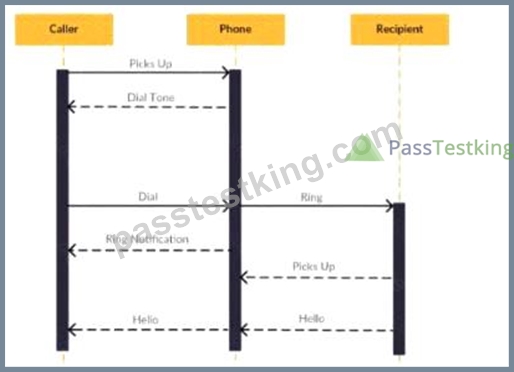
What does a sequence diagram do?
- A. Shows an order of events but does not specify all interactions
- B. Shows interactions awl indicates an order of events
- C. Shows sialic elements of software
- D. Shows interactions but does not specify an order of events
Answer: B
Explanation:
A sequence diagram is a type of interaction diagram used in software engineering to model the interactions between objects within a system over time. It shows how objects interact with each other and the order in which those interactions occur. The sequence diagram is organized along two dimensions: horizontally to represent the objects involved, and vertically to represent the time sequence of interactions. This allows the diagram to depict not only the interactions but also the sequence of events as they occur over time12345.
Option B is incorrect because a sequence diagram does indeed specify an order of events. Option C is incorrect as sequence diagrams do not show static elements of software but rather the dynamic interactions. Option D is also incorrect because a sequence diagram does show all interactions along with their order.
References: The purpose and structure of sequence diagrams are well-documented in various educational resources, such as Visual Paradigm1, Creately's guide2, and Wikipedia3. These sources provide detailed explanations and examples of sequence diagrams, confirming their use in displaying interactions and the order of events.
NEW QUESTION # 35
A programmer receives requirements from customers and deciders 1o build a first version of a program.
Which phase of an agile approach is being carried out when trio programmer starts writing the program's first version?
- A. Testing
- B. Design
- C. Analysis
- D. Implementation
Answer: D
Explanation:
In the context of Agile software development, when a programmer begins writing the first version of a program after receiving requirements from customers, they are engaging in the Implementation phase. This phase is characterized by the actual coding or development of the software, where the focus is on turning the design and analysis work into a working product. It's a part of the iterative process where developers create, test, and refine the software in successive iterations.
The Agile approach emphasizes incremental development and frequent feedback, with each iteration resulting in a potentially shippable product increment. The Implementation phase is where these increments are built, and it typically follows the Design phase, where the system's architecture and components are planned out.
References: The information aligns with the key stages of the Agile Development Life Cycle, which includes the phases of Concept, Inception, Iteration (Implementation), Testing, Release, and Review12.
NEW QUESTION # 36
What is the purpose of an activity diagram, such as the following diagram?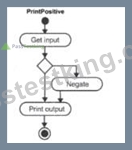
- A. Describes the execution flow of the PrintPositive activity
- B. Visualizes the program's data values
- C. Specifics the program's components that must be present
- D. Specifies the program's behavioral requirements
Answer: A
Explanation:
* Activity diagrams are another type of UML diagram used to model the workflow or flow of control within a system.
* They visually represent the steps performed by a system to complete a specific activity.
* They use a set of symbols, including rounded rectangles for activities, diamonds for decisions, and arrows to show the flow between steps.
* The activity diagram shows the workflow of a process called "PrintPositive".
* It starts with a single initial state (represented by a black circle) labeled "Get Input".
* There's a decision diamond labeled "Negative?" with two paths.
* The "Yes" path leads to an activity "Negate".
* The "No" path leads directly to an activity "Print Output".
* Both paths end with a black circle labeled "End".
How it describes the execution flow:
* The diagram indicates that the process starts by getting some input.
* Then, there's a decision made based on whether the input is negative.
* If it's negative, the value is negated.
* In either case (positive or negative), the output is printed.
* Finally, the process ends.
Summary:
The activity diagram captures the steps involved in the "PrintPositive" activity, including the decision-making process and the alternative paths based on the input. This aligns with the purpose of describing the execution flow.
NEW QUESTION # 37
Which action occurs during the design phase of an Agile process?
- A. Determining the functions that need to be written
- B. Writing the required objects
- C. Determining the goals of the project
- D. Deciding on the name of the program
Answer: A
Explanation:
Comprehensive and Detailed Explanation From Exact Extract:
In Agile, the design phase focuses on creating technical specifications and plans for implementing the software, including identifying functions, classes, or modules. According to foundational programming principles, this phase bridges requirements (from analysis) to coding (in implementation).
* Option A: "Determining the functions that need to be written." This is correct. During the design phase, the team specifies the functions, methods, or components (e.g., function signatures, class methods) required to meet the requirements. For example, designing a calculateTotal() function for an e- commerce system occurs here.
* Option B: "Determining the goals of the project." This is incorrect. Project goals are established during the analysis phase, where requirements and user stories are defined.
* Option C: "Writing the required objects." This is incorrect. Writing code (e.g., implementing classes or objects) occurs during the implementation phase, not design.
* Option D: "Deciding on the name of the program." This is incorrect. Naming the program is a minor decision, typically made earlier (e.g., during project initiation or analysis), and is not a primary focus of the design phase.
Certiport Scripting and Programming Foundations Study Guide (Section on Agile Design Phase).
Agile Alliance: "Agile Design" (https://www.agilealliance.org/glossary/design/).
Fowler, M., Refactoring: Improving the Design of Existing Code (design principles in Agile).
NEW QUESTION # 38
Which two statement describe advantages to using programming libraries? Choose 2 answers
- A. Using a library prevents a programmer from having to code common tasks by hand
- B. A program that uses libraries is more portable than one that does not
- C. Libraries always make code run faster.
- D. Using libraries turns procedural code into object-oriented code.
- E. Using a library minimizes copyright issues in coding.
- F. The programmer can improve productivity by using libraries.
Answer: A,F
Explanation:
Programming libraries offer a collection of pre-written code that developers can use to perform common tasks, which saves time and effort. This is because:
* B. Libraries provide pre-coded functions and procedures, which means programmers don't need to write code from scratch for tasks that are common across many programs. This reuse of code enhances efficiency and reduces the potential for errors in coding those tasks.
* E. By using libraries, programmers can significantly improve their productivity. Since they are not spending time writing and testing code for tasks that the library already provides, they can focus on the unique aspects of their own projects.
NEW QUESTION # 39
A program adds a service fee to the total cost of concert tickets when the tickets are printed and mailed to customers. Another service fee is also added if the
- A. Multiple if statements
- B. While loop
- C. If statement
- D. Do-while loop
Answer: A
Explanation:
The scenario describes conditional logic where service fees depend on these factors:
* Printing: There seems to be a base service fee whenever tickets are printed.
* Mailing: An additional fee applies if tickets are printed and mailed.
The most suitable way to model this logic is using multiple if statements:
* First if: Checks if tickets are printed. If so, add the base printing fee.
* Second if (nested): Checks if tickets are mailed (and by implication, already printed). If so, add the mailing fee.
NEW QUESTION # 40
Which kind of languages are C and Java?
- A. Machine code
- B. Markup
- C. Compiled
- D. Interpreted
Answer: C
Explanation:
Comprehensive and Detailed Explanation From Exact Extract:
C and Java are both compiled languages, though they differ in their compilation process. According to foundational programming principles, C is compiled directly to machine code, while Java is compiled to bytecode, which is executed by the Java Virtual Machine (JVM).
* Option A: "Machine code." This is incorrect. Machine code is the low-level output of a compiler, not a programming language. C and Java are high-level languages.
* Option B: "Compiled." This is correct. C is compiled to machine code (e.g., .exe files), and Java is compiled to bytecode (.class files), which is then executed by the JVM. Both require a compilation step before execution.
* Option C: "Interpreted." This is incorrect. Neither C nor Java is interpreted. While Java's bytecode is executed by the JVM, the compilation to bytecode distinguishes it from interpreted languages like Python, which execute source code directly.
* Option D: "Markup." This is incorrect. Markup languages (e.g., HTML) are used for structuring content, not programming. C and Java are programming languages.
Certiport Scripting and Programming Foundations Study Guide (Section on Compiled Languages).
Java Documentation: "The Java Compiler" (https://docs.oracle.com/javase/8/docs/technotes/tools/windows
/javac.html).
W3Schools: "C Introduction" (https://www.w3schools.com/c/c_intro.php).
NEW QUESTION # 41
A programming team is using the Waterfall design approach to create an application. Which deliverable would be produced during the design phase?
- A. The programming paradigm to be used
- B. A written description of the goals for the project
- C. A report of customer satisfaction
- D. A list of additional features to be added during revision
Answer: A
Explanation:
Comprehensive and Detailed Explanation From Exact Extract:
The Waterfall methodology is a linear, sequential approach to software development, with distinct phases:
requirements analysis, design, implementation, testing, and maintenance. According to foundational programming principles (e.g., Certiport Scripting and Programming Foundations Study Guide), the design phase in Waterfall produces technical specifications, including architectural decisions like the programming paradigm.
* Waterfall Design Phase:
* Translates requirements into a detailed blueprint for implementation.
* Deliverables include system architecture, data models, programming paradigm (e.g., object- oriented, procedural), and module specifications.
* Option A: "The programming paradigm to be used." This is correct. During the design phase, the team decides on the programming paradigm (e.g., object-oriented for Java, procedural for C) to structure the application, as this guides implementation. This is a key deliverable.
* Option B: "A list of additional features to be added during revision." This is incorrect. Additional features are identified during requirements analysis or later maintenance phases, not design.
* Option C: "A report of customer satisfaction." This is incorrect. Customer satisfaction reports are generated during or after deployment (maintenance phase), not design.
* Option D: "A written description of the goals for the project." This is incorrect. Project goals are defined during the requirements analysis phase, not design.
Certiport Scripting and Programming Foundations Study Guide (Section on Waterfall Methodology).
Sommerville, I., Software Engineering, 10th Edition (Chapter 2: Waterfall Model).
Pressman, R.S., Software Engineering: A Practitioner's Approach, 8th Edition (Waterfall Design Phase).
NEW QUESTION # 42
A particular sorting takes integer list 10,8 and incorrectly sorts the list to 6, 10, 8.
What is true about the algorithm's correctness for sorting an arbitrary list of three integers?
- A. The algorithm is correct
- B. The algorithm is incorrect
- C. The algorithm only works for 10,6, 8
- D. The algorithm's correctness is unknown
Answer: B
Explanation:
The correctness of a sorting algorithm is determined by its ability to sort a list of elements into a specified order, typically non-decreasing or non-increasing order. For an algorithm to be considered correct, it must consistently produce the correct output for all possible inputs. In the case of the given algorithm, it takes the input list [10, 8] and produces the output [6, 10, 8], which is not sorted in non-decreasing order. This indicates that the algorithm does not correctly sort the list, as the output is neither sorted nor does it maintain the integrity of the original list (the number 6 was not in the original list).
Furthermore, the fact that the output contains an integer (6) that was not present in the input list suggests that the algorithm is not preserving the elements of the input list, which is a fundamental requirement for a sorting algorithm. This violation confirms that the algorithm is incorrect for sorting an arbitrary list of three integers, as it cannot be relied upon to sort correctly or maintain the original list elements.
References: The principles of algorithm correctness can be found in various computer science literature and online resources. They often involve ensuring that the algorithm adheres to its preconditions and postconditions, and that it produces a valid output for all valid inputs1234.
NEW QUESTION # 43
Oder the tasks needed to safely replace a lamp's light bulb from first (1) to last (4).
Select your answer from the pull down list.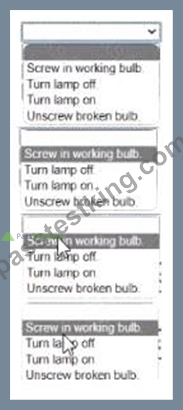
Answer:
Explanation: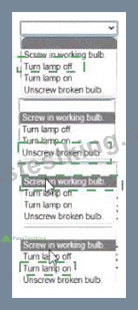
Explanation: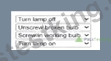
Safety and proper procedure are paramount when replacing a light bulb to avoid any electrical hazards or injuries. First, always ensure the lamp is turned off to prevent electrical shock. Next, carefully unscrew the broken or burnt-out bulb from the socket; it might be hot, so caution is advised. After removing the old bulb, screw in the new working bulb securely but without overtightening to avoid damaging the bulb or socket.
Finally, turn the lamp on to verify that the new bulb is functioning properly.
References The answer and explanation are based on general knowledge and common safety practices for handling electrical appliances; specific documents or standards on Scripting and Programming Foundations are not applicable here.
The image displays multiple-choice options for ordering tasks needed to safely replace a lamp's light bulb, providing an interactive learning method for understanding safety procedures in handling electrical items.
NEW QUESTION # 44
What is an accurate way to describe a statically typed language?
- A. It is based on the concept of modularization and calling procedures or subroutines.
- B. It requires a large number of variables and variable conversions because of the need to commit to a variable type throughout the life of the program.
- C. It uses methods that that produce consistent output based upon the arguments passed to those methods.
- D. It includes custom variable types with methods, information hiding, data abstraction, encapsulation, polymorphism, and inheritance.
Answer: B
Explanation:
A statically typed language is one where the type of a variable is known at compile time. This means that the type of each variable must be declared and does not change throughout the program's execution. While this can lead to a larger number of variable declarations and sometimes conversions, it also allows for type checking at compile time, which can catch many errors before the program runs. Statically typed languages include Java, C, C++, and others123.
NEW QUESTION # 45
......
Download Free Latest Exam Scripting-and-Programming-Foundations Certified Sample Questions: https://www.passtestking.com/WGU/Scripting-and-Programming-Foundations-practice-exam-dumps.html
Scripting-and-Programming-Foundations Actual Questions - Instant Download 140 Questions: https://drive.google.com/open?id=19NL8Ygpm2bOCTsWYi1eQoKE4zv7tTvwq