

1Z0-1085-20 Pre-Exam Practice Tests | (Updated 100 Questions)
Valid 1Z0-1085-20 Exam Q&A PDF - One Year Free Update
Oracle 1Z0-1085-20 Exam Syllabus Topics:
| Topic | Details |
|---|---|
| Topic 1 |
|
| Topic 2 |
|
| Topic 3 |
|
NEW QUESTION 50
According to shared security model, which two are a customer's responsibilities in Oracle Cloud Infrastructure (OCI)? (Choose two.)
- A. Physical security of OCI data center facilities
- B. Customer data
- C. Virtual Machine hypervisor
- D. Object Storage data durability
- E. Local NVMe data persistence
Answer: B,D
Explanation:
Explanation/Reference: https://cloudcheckr.com/cloud-security/shared-responsibility-model/
NEW QUESTION 51
What service is NOT available as part of Oracle Cloud Free Tier?
- A. Oracle Cloud Infrastructure Exadata DB Systems
- B. Oracle Cloud Infrastructure Autonomous Data Warehouse
- C. Oracle Cloud Infrastructure Compute
- D. Oracle Cloud Infrastructure Monitoring
Answer: A
Explanation:
Explanation
For more information on Oracle Cloud Infrastructure Free Tier refer below official documentation
https://docs.cloud.oracle.com/en-us/iaas/Content/FreeTier/freetier.htm?Highlight=Free%20Tier Exadata DB Systems aren't a part of the free tier: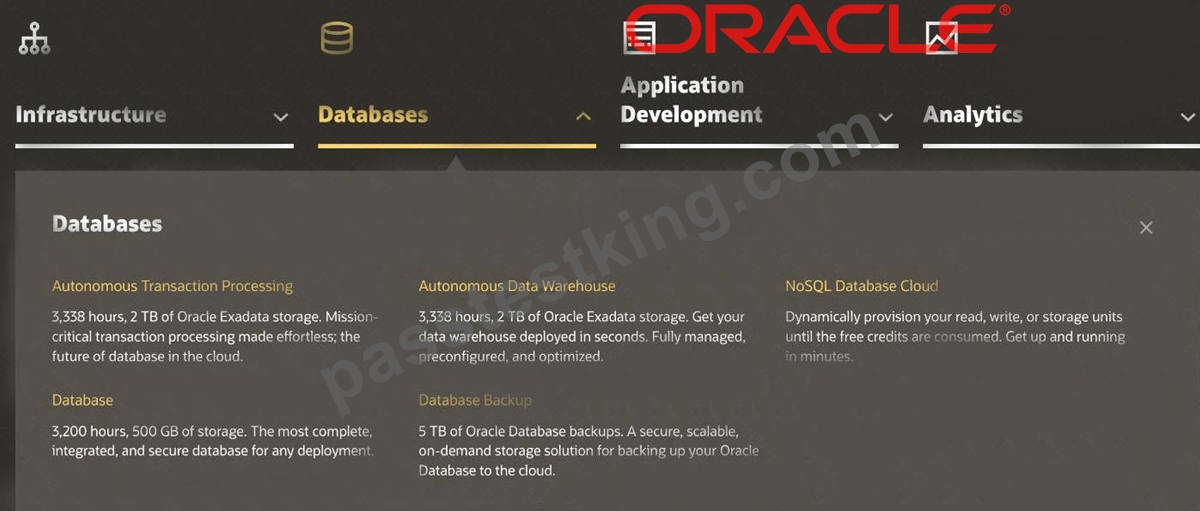
NEW QUESTION 52
A banking platform has been re-designed to a microservices based architecture using Docker containers for deployment.
Which service can you use to deploy containers on Oracle Cloud Infrastructure (OCI)?
- A. Container Engine for Kubernetes (OKE)
- B. Streaming Service
- C. API Gateway
- D. File Storage Service
Answer: A
Explanation:
Explanation
Oracle Cloud Infrastructure Container Engine for Kubernetes is a fully-managed, scalable, and highly available service that you can use to deploy your containerized applications to the cloud. Use Container Engine for Kubernetes (sometimes abbreviated to just OKE) when your development team wants to reliably build, deploy, and manage cloud-native applications. You specify the compute resources that your applications require, and Container Engine for Kubernetes provisions them on Oracle Cloud Infrastructure in an existing OCI tenancy.
Container Engine for Kubernetes uses Kubernetes - the open-source system for automating deployment, scaling, and management of containerized applications across clusters of hosts. Kubernetes groups the containers that make up an application into logical units (called pods) for easy management and discovery.
You can access Container Engine for Kubernetes to define and create Kubernetes clusters using the Console and the REST API. You can access the clusters you create using the Kubernetes command line (kubectl), the Kubernetes Dashboard, and the Kubernetes API.
Container Engine for Kubernetes is integrated with Oracle Cloud Infrastructure Identity and Access Management (IAM), which provides easy authentication with native Oracle Cloud Infrastructure identity functionality.
NEW QUESTION 53
A customer wants a dedicated connection with minimal network latency from their on-premises data center to Oracle Cloud Infrastructure (OCI).
Which service should they choose?
- A. IPSec Virtual Private Network (VPN)
- B. Public internet
- C. Virtual Cloud Network Remote Peering
- D. OCI FastConnact
Answer: D
NEW QUESTION 54
What does Oracle's Payment Card Industry Data Security Standard (PCI DSS) attestation of compliance provide to customers?
- A. Customers can use these services for workloads that store, process, or transmit cardholder data.
- B. Customers can use these services for workloads that provides validation of card holder transaction but only as 3rd party
- C. Customers can use these services for workloads that process, or transmit cardholder data but not store it.
- D. Customers can use these services for workloads to process applications for credit card approval securely.
Answer: A
NEW QUESTION 55
A new customer has logged into Oracle Cloud Infrastructure (OCI) as an administrator for the first time. The admin would like to deploy infrastructure. What is the first step they must take in order to accomplish this task?
- A. Use API endpoints to create resources in the desired region.
- B. File a service request for access to each additional region.
- C. Subscribe to the desired region.
- D. Navigate to the desired region and begin creating resources.
Answer: C
Explanation:
Explanation
When you sign up for Oracle Cloud Infrastructure, Oracle creates a tenancy for you in one region. This is your home region. Your home region is where your IAM resources are defined. When you subscribe to another region, your IAM resources are available in the new region, however, the master definitions reside in your home region and can only be changed there.
When you subscribe your tenancy to a new region, all the policies from your home region are enforced in the new region. If you want to limit access for groups of users to specific regions, you can write policies to grant access to specific regions only.
NEW QUESTION 56
Which Oracle Cloud infrastructure service can you use to assess user security of your Oracle databases?
- A. Audit Vault and Database Firewall option for Oracle Database Enterprise Edition
- B. Oracle Data Guard
- C. Audit Service
- D. Oracle Data Safe
Answer: D
Explanation:
Explanation/Reference: https://docs.cloud.oracle.com/en-us/iaas/data-safe/doc/oracle-data-safe-overview.html
NEW QUESTION 57
Which two security capabilities are offered by Oracle Cloud Infrastructure?
- A. Always on data encryption for data-at-rest.
- B. Certificate Management service
- C. Managed Active Directory service
- D. Key Management service
- E. Captcha
Answer: A,D
NEW QUESTION 58
After Signing up for a new Oracle cloud Infrastructure tenancy, what would you subscribe to in order to deploy infrastructure and services in different parts of the world?
- A. Availability Domain
- B. Fault Domains
- C. Region
- D. Pay as you go pricing
Answer: C
Explanation:
Explanation
Oracle Cloud Infrastructure is hosted in regions and availability domains. A region is a localized geographic area, and an availability domain is one or more data centers located within a region. A region is composed of one or more availability domains. Most Oracle Cloud Infrastructure resources are either region-specific, such as a virtual cloud network, or availability domain-specific, such as a compute instance. Traffic between availability domains and between regions is encrypted. Availability domains are isolated from each other, fault tolerant, and very unlikely to fail simultaneously. Because availability domains do not share infrastructure such as power or cooling, or the internal availability domain network, a failure at one availability domain within a region is unlikely to impact the availability of the others within the same region.
The availability domains within the same region are connected to each other by a low latency, high bandwidth network, which makes it possible for you to provide high-availability connectivity to the internet and on-premises, and to build replicated systems in multiple availability domains for both high-availability and disaster recovery.
Oracle is adding multiple cloud regions around the world to provide local access to cloud resources for our customers. To accomplish this quickly, we've chosen to launch regions in new geographies with one availability domain.
As regions require expansion, we have the option to add capacity to existing availability domains, to add additional availability domains to an existing region, or to build a new region. The expansion approach in a particular scenario is based on customer requirements as well as considerations of regional demand patterns and resource availability.
For any region with one availability domain, a second availability domain or region in the same country or geo-political area will be made available within a year to enable further options for disaster recovery that support customer requirements for data residency where they exist.
NEW QUESTION 59
Which OCI service should you implement?
- A. Internet Gateway
- B. VCN Peering
- C. IPSec VPN
- D. FastConnect
Answer: A
NEW QUESTION 60
you are analyzing your Oracle Cloud Infrastructure (OCI) usage with Cost Analysis tool in OCI Console.
Which is not a default feature of the tool?
- A. Filter costs by date
- B. Filter costs by tags
- C. Filter costs by compartments
- D. Filter costs by applications
Answer: D
Explanation:
Explanation
You can filter Costs Analysis Tools by following three ways
To filter costs by dates
To filter costs by tags
To filter costs by compartments
NEW QUESTION 61
Which OCI storage service does not provide encryption for data at rest?
- A. Local NVMe
- B. Object Storage
- C. Block Volume
- D. File Storage
Answer: A
Explanation:
Explanation
NVMe stands for non-volatile memory express. It is a storage protocol created to fasten the transfer of data between enterprise and client systems and solid-state drives (SSDs) over a computer's high-speed Peripheral Component Interconnect Express bus. The characteristics are:
1) Local NVMe is NVMe SSD-based temporary storage.
2) It is the locally-attached NVMe devices to the OCI compute instance
3) It is used very high storage performance requirements, lots of throughput, lots of IOPS, local storage and when you don't want to go out on network
4) Oracle does not protect in any way through RAID, or snapshots, or backup out of the box and data is not encrypted at rest.
NEW QUESTION 62
A customer wants to deploy a customized e commerce Web application using multiple virtual machines, block storage, databases, load balancer and web application firewall.
What cloud model can be used to host this application?
- A. Anything as a Service (XaaS)
- B. Platform as a Service (PaaS)
- C. Infrastructure as a Service (IaaS)
- D. Software as a Service (SaaS)
Answer: D
NEW QUESTION 63
A new customer has logged into Oracle Cloud Infrastructure (OCI) as an administrator for the first time. The admin would like to deploy Infrastructure into a region other then their home region.
What is the first Stop they must take in order to accomplish this task?
- A. Use API endpoints to create resources in the desired region.
- B. File a service request for access to each additional region.
- C. Subscribe to the desired region.
- D. Navigate to the desired region and begin creating resources.
Answer: C
Explanation:
Explanation
When you sign up for Oracle Cloud Infrastructure, Oracle creates a tenancy for you in one region. This is your home region. Your home region is where your IAM resources are defined. When you subscribe to another region, your IAM resources are available in the new region, however, the master definitions reside in your home region and can only be changed there.
When you subscribe your tenancy to a new region, all the policies from your home region are enforced in the new region. If you want to limit access for groups of users to specific regions, you can write policies to grant access to specific regions only.
NEW QUESTION 64
You want to migrate mission-critical Oracle E-Business Suite application to Oracle Cloud Infrastructure (OCI) with full control and access to the underlying infrastructure.
Which option meets this requirement?
- A. Oracle Exadata Cloud at customer, Storage Gateway and API Gateway
- B. OCI Exadata DB Systems and Oracle Functions
- C. OCI Exadata DB Systems and OCI compute instances
- D. Replace E-Business Suite with an Oracle SaaS application
Answer: D
NEW QUESTION 65
What does compute instance vertical scaling mean?
- A. Enabling Disaster recovery
- B. Adding additional compute instances
- C. Changing to a large or smaller shape
- D. Providing Fault tolerance
Answer: C
Explanation:
Explanation
Changing the Shape of an Instance (Horizontal Scaling)
You can change the shape of a virtual machine (VM) instance without having to rebuild your instances or redeploy your applications. This lets you scale up your Compute resources for increased performance, or scale down to reduce cost.
Autoscaling (vertical scaling)
Autoscaling lets you automatically adjust the number of Compute instances in an instance pool based on performance metrics such as CPU utilization. This helps you provide consistent performance for your end users during periods of high demand, and helps you reduce your costs during periods of low demand.
As load increases, instances are automatically provisioned: the instance pool scales out. As load decreases, instances are automatically removed: the instance pool scales in.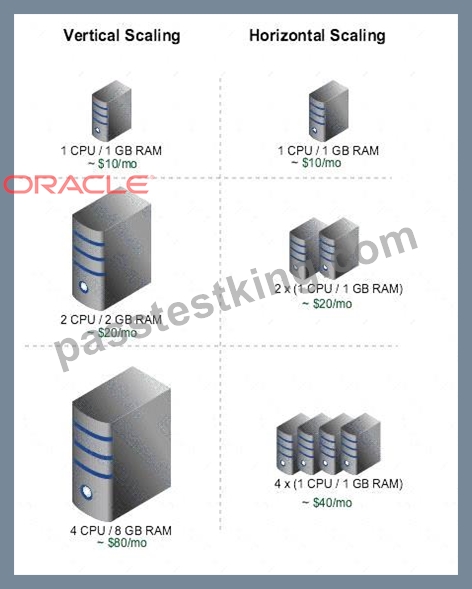
https://docs.cloud.oracle.com/en-us/iaas/Content/Compute/Tasks/resizinginstances.htm
NEW QUESTION 66
Which is NOT a valid business benefit for a customer considering migrating their infrastructure and apps to Oracle Cloud Infrastructure (OCI).
- A. Faster go-to market
- B. Increased Total Cost of Ownership (TCO)
- C. Greater agility
- D. Capital Expenditure to Operational Expenditure conversion
Answer: A
NEW QUESTION 67
A customer wants to deploy a customized e commerce Web application using multiple virtual machines, block storage, databases, load balancer and web application firewall.
What cloud model can be used to host this application?
- A. Anything as a Service (XaaS)
- B. Software as a Service (SaaS)
- C. Infrastructure as a Service (IaaS)
- D. Platform as a Service (PaaS)
Answer: C
Explanation:
Explanation
https://www.oracle.com/cloud/what-is-iaas/
What Is IaaS?
Infrastructure as a service (IaaS) is a type of cloud service model in which computing resources are hosted in the cloud. Businesses can use the IaaS model to shift some or all of their use of on-premises or colocated data center infrastructure to the cloud, where it is owned and managed by a cloud provider. These infrastructure elements can include compute, network, and storage hardware as well as other components and software.
In the IaaS model, the cloud provider owns and operates the hardware and software and also owns or leases the data center. When you have an IaaS solution, you rent the resources like compute or storage, provision them when needed, and pay for the resources your organization consumes. For some resources such as compute, you'll pay for the resources you use. For others such as storage, you'll pay for capacity.
How Does IaaS Work?
In a typical IaaS model, a business-which can be of any size-consumes services like compute, storage, and databases from a cloud provider. The cloud provider offers those services by hosting hardware and software in the cloud. The business will no longer need to purchase and manage its own equipment, or space to host the equipment, and the cost will shift to a pay-as-you-go model. When the business needs less, it pays for less.
And when it grows, it can provision additional computing resources and other technologies in minutes.
In contrast, in a traditional on-premises scenario, a business manages and maintains its own data center. The business must invest in servers, storage, software, and other technologies, and hire an IT staff or contractors to purchase, manage, and upgrade all the equipment and licenses. The data center has to be built to meet peak demand, even though sometimes workloads decline and those resources stand idle. Conversely, if the business grows quickly, the IT department might struggle to keep up.
NEW QUESTION 68
What service is NOT available as part of Oracle Cloud Free Tier?
- A. Oracle Cloud Infrastructure Exadata DB Systems
- B. Oracle Cloud Infrastructure Autonomous Data Warehouse
- C. Oracle Cloud Infrastructure Compute
- D. Oracle Cloud Infrastructure Monitoring
Answer: A
Explanation:
Explanation/Reference: https://www.oracle.com/cloud/free/
NEW QUESTION 69
Which Oracle Cloud Infrastructure (OCI) service can be used to protect sensitive and regulated data in OCI database services?
- A. Oracle Data Guard
- B. OCI Audit
- C. Oracle Data Safe
- D. OCI OS management
Answer: C
Explanation:
Explanation
Oracle Data Safe is a unified control center for your Oracle databases which helps you understand the sensitivity of your data, evaluate risks to data, mask sensitive data, implement and monitor security controls, assess user security, monitor user activity, and address data security compliance requirements.
Whether you're using an Autonomous Database or an Oracle DB system, Oracle Data Safe delivers essential data security capabilities as a service on Oracle Cloud Infrastructure.
Features of Oracle Data Safe:
Oracle Data Safe provides the following set of features for protecting sensitive and regulated data in Oracle Cloud databases, all in a single, easy-to-use management console:
1) Security Assessment helps you assess the security of your cloud database configurations. It analyzes database configurations, user accounts, and security controls, and then reports the findings with recommendations for remediation activities that follow best practices to reduce or mitigate risk.
2) User Assessment helps you assess the security of your database users and identify high risk users. It reviews information about your users in the data dictionary on your target databases, and calculates a risk score for each user. For example, it evaluates the user types, how users are authenticated, the password policies assigned to each user, and how long it has been since each user has changed their password. It also provides a direct link to audit records related to each user. With this information, you can then deploy appropriate security controls and policies.
3) Data Discovery helps you find sensitive data in your cloud databases. You tell Data Discovery what kind of sensitive data to search for, and it inspects the actual data in your database and its data dictionary, and then returns to you a list of sensitive columns. By default, Data Discovery can search for a wide variety of sensitive data pertaining to identification, biographic, IT, financial, healthcare, employment, and academic information.
4) Data Masking provides a way for you to mask sensitive data so that the data is safe for non-production purposes. For example, organizations often need to create copies of their production data to support development and test activities. Simply copying the production data exposes sensitive data to new users. To avoid a security risk, you can use Data Masking to replace the sensitive data with realistic, but fictitious data.
5) Activity Auditing lets you audit user activity on your databases so you can monitor database usage and be alerted of unusual database activities.
NEW QUESTION 70
Which Oracle Cloud Infrastructure (OCI) service can be used to protect sensitive and regulated data in OCI database services?
- A. Oracle Data Guard
- B. OCI Audit
- C. Oracle Data Safe
- D. OCI OS management
Answer: C
Explanation:
Explanation/Reference: https://docs.cloud.oracle.com/en-us/iaas/data-safe/index.html
NEW QUESTION 71
After Signing up for a new Oracle cloud Infrastructure tenancy, what would you subscribe to in order to deploy infrastructure and services in different parts of the world?
- A. Availability Domain
- B. Fault Domains
- C. Region
- D. Pay as you go pricing
Answer: C
Explanation:
Explanation
Oracle Cloud Infrastructure is hosted in regions and availability domains. A region is a localized geographic area, and an availability domain is one or more data centers located within a region. A region is composed of one or more availability domains. Most Oracle Cloud Infrastructure resources are either region-specific, such as a virtual cloud network, or availability domain-specific, such as a compute instance. Traffic between availability domains and between regions is encrypted.
NEW QUESTION 72
......
Oracle Cloud Infrastructure Foundations 2020 Associate Free Update Certification Sample Questions: https://www.passtestking.com/Oracle/1Z0-1085-20-practice-exam-dumps.html